
Minister Attends Caribbean Disability Conference
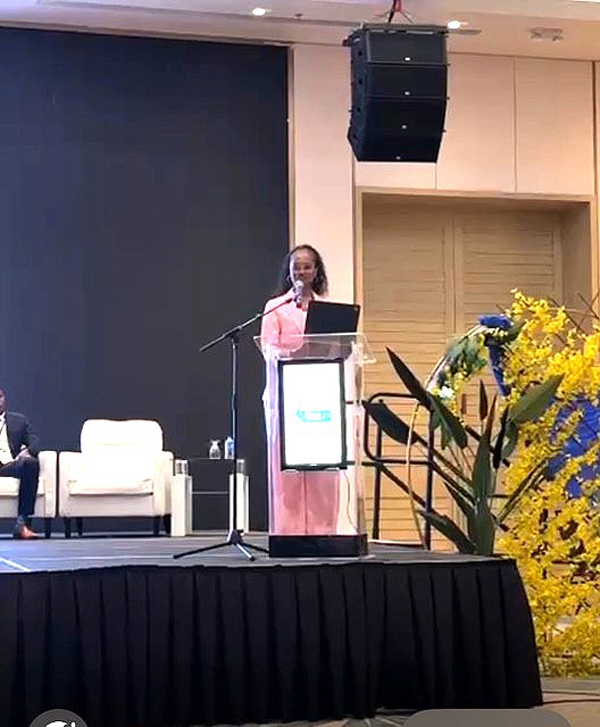
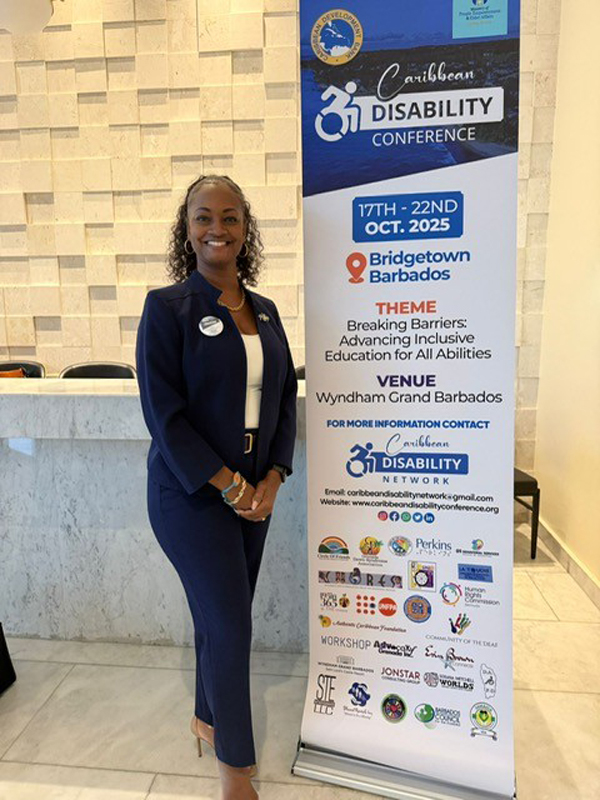
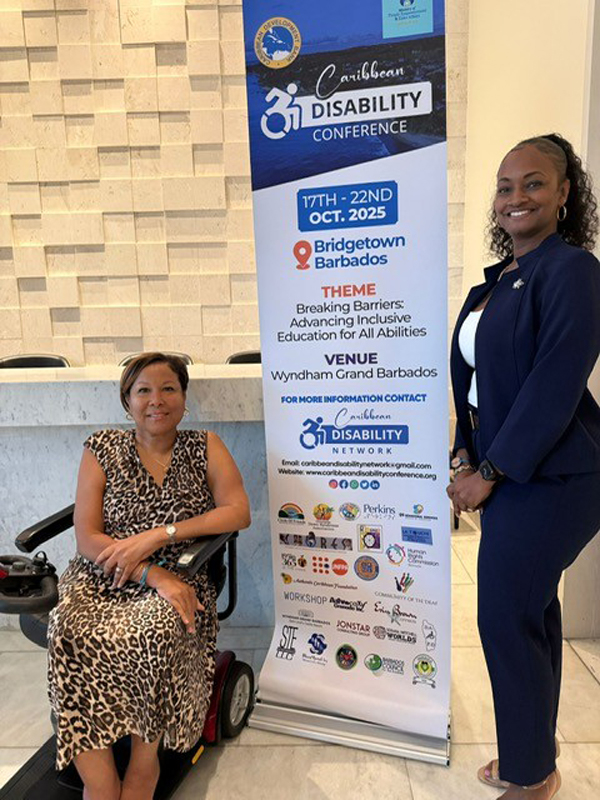
The Minister of Education Crystal Caesar recently delivered remarks at the Caribbean Disability Network’s [CDN] second annual Caribbean Disability Conference, held in Bridgetown, Barbados, under the theme ‘Breaking Barriers: Advancing Inclusive Education for All Abilities.’
A spokesperson said, “This year’s conference focused on inclusive education. The goal of the conference underscored UNESCO’s definition for inclusive education as the ‘process of addressing and responding to the diversity of needs of all children, youth and adults through increasing participation in learning, cultures and communities, and reducing and eliminating exclusion within and from education.
“It involves changes and modifications in content, approaches, structures and strategies, with a common vision that covers all children of the appropriate age range and a conviction that it is the responsibility of the regular system to educate all children’.
“A diverse group of stakeholders, including the Executive Officer for the Human Rights Commission of Bermuda, Mrs Lisa Reed, attended the conference. This group included government officials, educators, representatives from organisations serving people with disabilities, researchers, students, families, non-governmental organisations, funding agencies, and frontline service providers. Their collective presence underscored the broad support for the cause of inclusive education in the Caribbean.
“The organisers, CDN, invited Minister Caesar to deliver remarks on the final plenary session. The Minister was asked to reflect on the conference. She not only reflected but also reaffirmed her commitment to the cause. She emphasised that the conference was more than a space for discussion; the gathering served as a catalyst for transformation, regional support, and collaboration.”
In her remarks, Minister Caesar stated, “We have heard powerful stories, engaged in thoughtful dialogue, and challenged ourselves to rethink how, as a society, we can create a world where every person, regardless of ability, can live with dignity, independence, and opportunity. Today, we must reaffirm that inclusion is not an act of charity. It is a matter of rights, of respect, and of shared humanity. Our schools are a crucial part of this vision. They must be safe spaces, free from bullying and teasing, where every learner feels respected and supported.
“Teachers play a vital role in shaping this environment. They must model inclusive behaviour, promote empathy, and be trained to meet diverse learning needs. This includes the ability to differentiate instruction, to integrate assistive technologies, and to identify students who may require interventions or support to access the curriculum equitably.
“As a government, our commitment is to a future where social exclusion is replaced by belonging, where services are dignified and accessible, and where every person has the opportunity to fulfil their potential. True inclusion must be normalised, not exceptional, but woven into the fabric of everyday life. When inclusion becomes the norm, communities grow more empathetic, workplaces become more diverse, and societies become more just. Normalising inclusion fosters sensitisation of the community at large, helping society to value difference as a source of strength rather than division.”
As the Minister concluded, her words echoed the essence of the conference. “Inclusion is not a one-size-fits-all concept; it is about equity, flexibility, and compassion. These principles should guide our actions and decisions in the context of inclusion.”
The spokesperson said, “By its close, CDN and partners adopted a Caribbean Declaration on Inclusive Education and a regional action plan designed to drive implementation across the region, ensuring that no learner is left behind and promoting best practices and inclusive education frameworks.”



What about attending a “BDN” in Bermuda.
?.
“inclusive behaviour” – I hear what the Minister is saying, but the education systems in other countries are full of such failures. Outside of “inclusive” being a politically correct buzzword, the Minister should actually conduct some research.
The US is full of failed “inclusive” educational programs. For example:
A wheelchair-bound student with no learning disabilities is not a disruption to a class of say 25 students. As long as the classroom is wheelchair accessible, of course.
Under “inclusion,” a student with learning disabilities would be mainstreamed with average to above-average students. The teacher ends up spending a disproportionate amount of time on that student, to the detriment of the remaining 24 students. Students suffer for the sake of political correctness. Now increase that to 2 or 3 students, and the negative impact is logarithmic. As part of a school improvement team, I sat in US classrooms and observed this. Several members of my family are/were teachers, and they all said the same thing.
Another example: in a classroom of 25 students, some teachers break the class into groups of 5, with a really smart student in each group. The teacher tells the students to help the other students with problems, thus abdicating the teacher’s role to a few students. Where did the smart kid get their training to coach a blind student or a hearing-impaired student? Is this what parents expected?
Inclusivity requires additional training for EVERY teacher, which adds to schools’ costs, as does annual refresher training.
What has been proven effective is having a few specially trained teachers with the proper instructional resources available in separate classroom(s) to teach those who would be disruptive if mainstreamed. This improves the overall education for everyone. Students would be mainstreamed once they achieve the established metric.
Another example of failure was a US study conducted many years ago that declared young girls were not pursuing careers in math and science. That was deemed unacceptable and somehow not inclusive as the ratio was “disproportionate.” As ordered, teachers focused on the girls and ignored the boys. Guess how that turned out. More boys dropped out of school, fewer took math and science classes, and as a percentage, fewer boys went to college than ever before. There needs to be a balance and common sense in implementing educational goals.
Didn’t the United States Federal Government just abolish all federal DEI programmes?
yeppers, by Executive Order on his first or second day in office.