Law To Legacy: Unravelling The Narrative
[Written by Don Burgess]
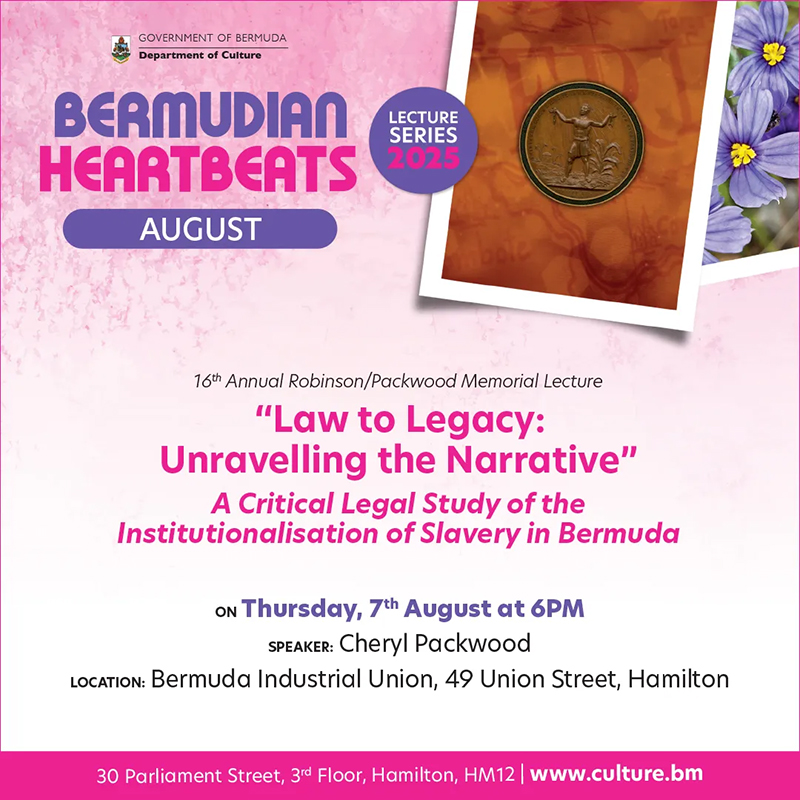
The upcoming 16th Annual Robinson/Packwood Memorial Lecture promises to challenge how Bermudians see their history and their place in the Atlantic world. This year’s lecture, titled “Law to Legacy: Unravelling the Narrative,” will be delivered by Cheryl Packwood on Thursday, August 7, 2025, at 6:00 PM at the Bermuda Industrial Union in Hamilton. The event is part of the Department of Culture’s Bermudian Heartbeats Lecture Series and is free to the public.
Despite having lectured around the world, Packwood admitted this lecture carries special weight.
“I’ve talked in so many places, but being asked to do the Robinson/Packwood Lecture? That’s something different. That’s home,” she said. “It’s exciting and honestly, a little scary. When you speak to your own people, you want to get it right.”
Packwood will draw on her groundbreaking 2024 publication in the University of Pennsylvania Journal of International Law, where she made a compelling case that Bermuda, and not the mainland colonies, was the first in the British Empire to institutionalize slavery legally. Her lecture will centre on the 1623 Act passed in Bermuda, which she argues codified chattel slavery more than 40 years before similar laws were introduced in Virginia and other mainland colonies.
“Bermuda passed a law in 1623 that talked about ‘ownership’ of people,” Packwood said. “When you refer to human beings as property, you’re not just talking about social conditions. You’re writing slavery into law.”
Her academic article, “A Forgotten Colonial Past,” highlighted how Bermuda, just eleven years after settlement, was already enacting legislation, judicial decisions, and proclamations that established slavery as a legal and economic institution. She added that laws enslaving Black people in Bermuda dated back even earlier, to 1617, and that Bermuda should be viewed as a legal forerunner to its sister colonies on the North American mainland.
In her article, Packwood examined how laws denied Black people and other people of colour fundamental human rights: the right to marry, to raise their children, to own property, or even to carry a weapon. These were not isolated practices, she noted, but codified exclusions embedded in Bermuda’s early legal framework.
“This isn’t just history; it’s a legal blueprint. Bermuda helped chart the course for British colonial law on slavery,” she said.
She also pointed out that while the 1623 Act has long been known to historians, its significance has often been overlooked. “Even in academic circles, people mention the law but avoid engaging with what ‘ownership’ really means. That’s the part that stunned me. It was right there.”