Column: Van Putten On Ashay Programme
 [Opinion column written by Mwalimu Melodye Micere Van Putten]
There has been so much conversation about the state of young people in Bermuda and how best to support them. These discussions surface whenever a tragic and avoidable situation occurs – whether violence, reckless motorcycling, or general anti-social behavior. While this challenge is multi-faceted with plenty of work to do, the Ashay Programme is one of the solid, proven pieces of the solution.
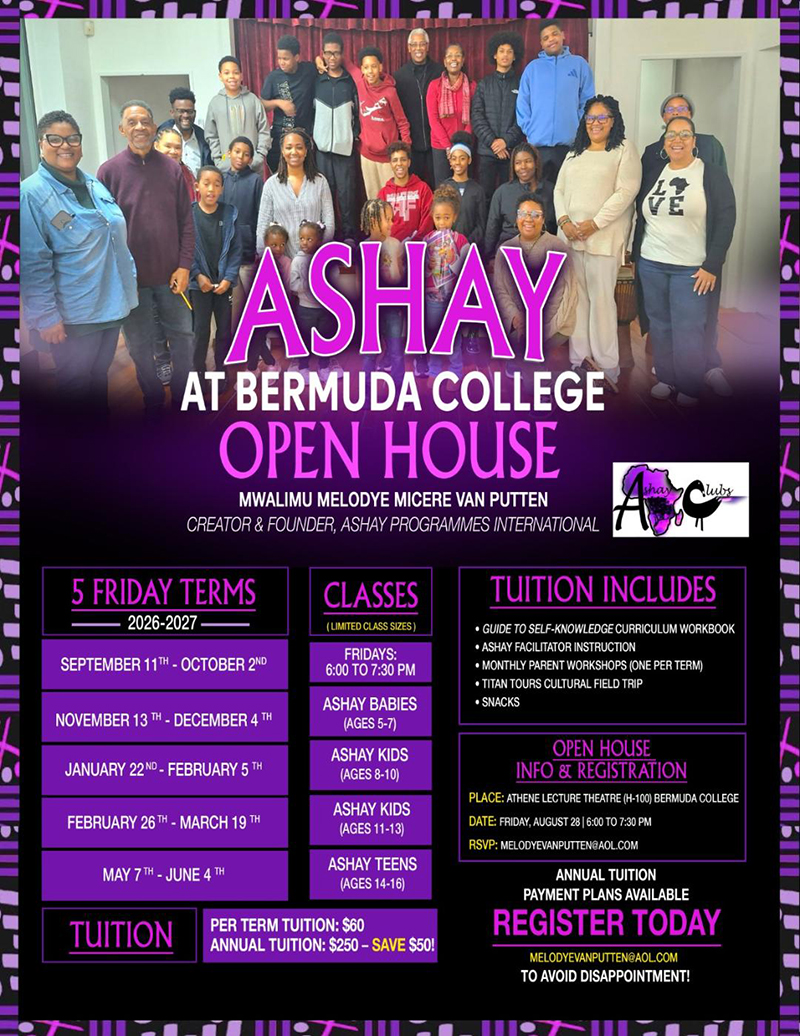
This September, Bermuda College and Ashay will partner to offer culturally relevant classes for young people and their parents.
Ashay at Bermuda College is, in many ways, long overdue. After 40 years of labouring in the vineyard of cultural education – from the United States to Ghana to Bermuda – this moment reflects a deep spiritual purpose and a lifelong commitment to our children and our culture.
Ashay provides young people with what I call “cultural grounding” which they are not getting in their academic experiences, through public or private schools. A traditional African proverb explains the situation perfectly! “If you don’t know where you come from, you can’t know where you are going. …and if you don’t know where you are going, any road will take you there!” Too many of our children – Black children – do not know who they are and are choosing roads going nowhere!
One solution – Ashay: Rites of Passage. Rites of passage is the idea of providing specific, ethnic education – cultural and historical, with values and standards. It was and is an ancient practice in traditional African ethnic groups. Boys and girls attend the rites, designed to teach values, responsibilities, and expectations as a passage to adulthood. Conducted by elders and community members skilled in various arts, it was and is intense and includes heritage, practical life skills, spirituality, and talent development. In fact, Sir Robert Baden-Powell observed traditional Zulu African rites of passage during his military colonisation tours in Africa. When he returned to the United Kingdom, he founded Boy Scouts based on African rites for young people in 1907. [He helped his sister, Agnes, found Girl Guides/Girl Scouts using the same principles.] Baden-Powell’s story of observing African rites of passage as the foundation of scouting is included in the Cub Scout Handbook as the “Story of Akela.” The practice of various ethnic groups gathering their youth for the specific transmission of history, culture, standards, values, and expectations includes Native, Jewish, and Asian peoples. Recently Bermuda’s Portuguese community announced open registration for cultural lessons for their children.
Young people who experience rites of passage develop a grounded sense of Self – rooted in history, culture, responsibilities, and identity. This foundation nurtures self-esteem, motivation, and pride. It gives them a purpose anchored in something larger than themselves. Echoing this truth, Ghana’s Rev. Sister Grace Nuamah, Principal of Atasemanso Primary School, wrote “… By helping us establish the Ashay Clubs at our school, you have provided our students with the tools for self-knowledge, pride, and self-determination. You have not only brought a program; you have brought a renewed sense of identity and excellence to our halls.”
Today, Ashay Clubs Ghana has upwards of 1,000 members and is active both in the school and throughout the Kumasi community.
Bermuda College President Dr. David Sam in an op-ed this past spring wrote, “Education changes the direction of lives. It opens doors to employment, confidence, independence and service. It gives young people the tools to adapt in a changing world…”
In terms of empirical evidence, various studies have documented the positive effects of cultural education over the decades. A recent study published in the American Educational Research Journal finds that “expanding ethnic studies courses across an entire school district can significantly improve student academic performance, adding some of the strongest evidence yet that culturally relevant curricula can succeed at scale. The study analyzed more than a decade of student data from the San Francisco Unified School District, tracking over 24,000 students from middle school through high school. Researchers found that students who took ethnic studies courses earned higher grade point averages and were less likely to fail classes.”
Since the initial announcement of Ashay at Bermuda College, I have been gratified to hear from former students, parents, and adult students in AshayU – the adult version of Ashay Clubs. I was particularly touched by one letter I received from a father whose two boys attended Ashay Clubs for a number of years. In response to reading the announcement, he wrote, “…This is a true testament of your passion and commitment to bring your wealth of knowledge of our people’s history to the forefront for everyone to enjoy and be educated in the wonderful history of our ancestors! All those that partake in these classes will be forever empowered and blessed with an increased awareness of our strength, perseverance and brilliance about our many ancestors that have gone before us and the strong shoulders we all stand on this day and the days to come!”
Ashay means “It is good.” It is indeed good for young people to know who they are and have goals for their future. I cordially invite you to attend Ashay at Bermuda College Open House to be held in the Athene Lecture Theatre on Friday, August 28th from 6:00 to 7:30 pm. Come, learn, and be inspired! Ashay!
- For more information on the programme, how to register, or RSVP for the Open House contact Mwalimu Van Putten via email at melodyevanputten@aol.com.
- Mwalimu Melodye Micere Van Putten