
Minister On Proposed Competition Legislation
The Government is conducting a consultation on a proposed competition framework, Minister of Home Affairs Alexa Lightbourne said, explaining that some of the measures under consideration include prohibiting anti-competitive agreements and abuse of a dominant market position, and requiring certain mergers and acquisitions in essential sectors to get approval.
Speaking in the House of Assembly on Friday [Oct 2], the Minister said, “I rise to update this Honourable House on the Government’s proposed competition framework, the consultation just completed, and the next steps towards modern competition legislation for Bermuda.
“The consultation document identifies concerns across the essential sectors. In healthcare, consolidation across insurance, medical practices, and pharmacy services raises questions of patient choice, access to independent providers, and arrangements that direct patients towards connected businesses.
“In grocery retail, consolidation sits alongside the structural challenges of a small market dependent on imported food. In pharmaceuticals, alternative suppliers, transparent pricing, and access for independent providers directly affect people who rely on regular medication.
“The proposed framework has four core elements.
“First, it would prohibit anti-competitive agreements, including price-fixing, market-sharing, bidrigging, and agreements to restrict production.
“Second, it would prohibit abuse of a dominant market position, including unfair pricing, restricted supply, discriminatory terms, and arrangements directing consumers towards connected businesses.
“Third, certain mergers and acquisitions in essential sectors would require approval before proceeding. Notification triggers scrutiny of whether a transaction would substantially lessen competition. It does not determine the outcome.
“Fourth, the Authority would hold powers to investigate suspected breaches and take enforcement action.
“These are the proposals consulted upon,” she added.
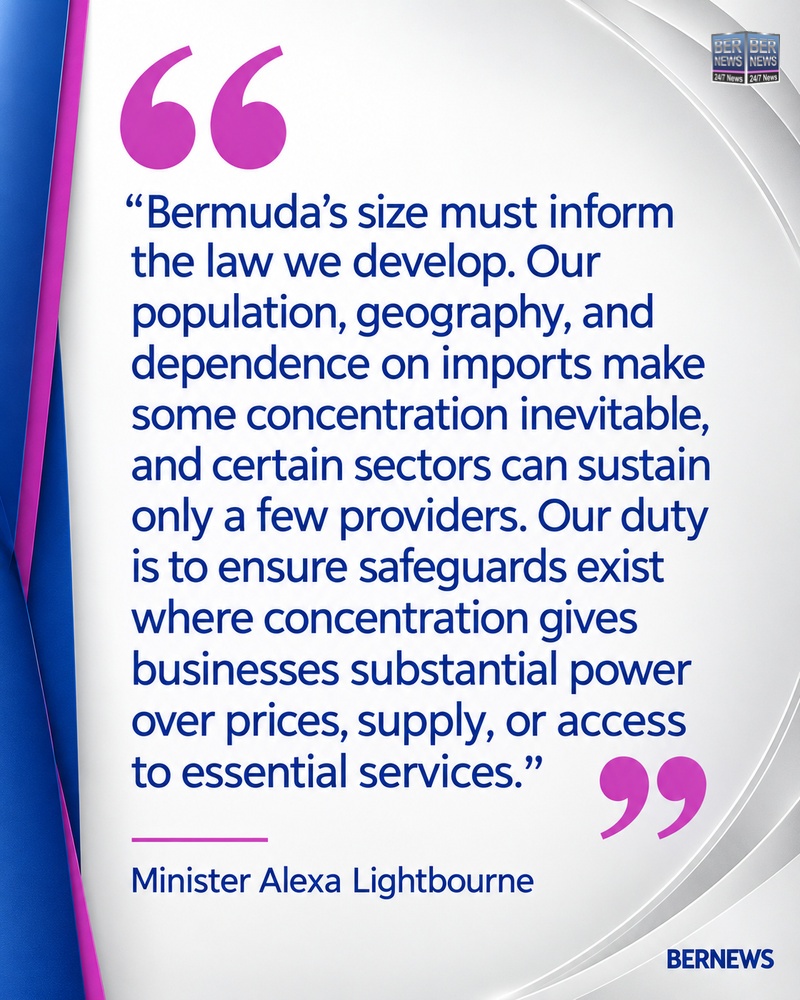
The Minister’s full statement follows below:
Mr. Speaker,
I rise to update this Honourable House on the Government’s proposed competition framework, the consultation just completed, and the next steps towards modern competition legislation for Bermuda.
In the 2024 and 2025 Throne Speeches, the Government pledged a general competition law. On 14 August 2026, the Ministry of Home Affairs published Promoting Competition and Market Fairness in Bermuda, setting out proposals for a Competition Act 2026. Public consultation closed on 15 September.
This work is about markets that operate fairly for the people and businesses who depend on them. We want businesses to grow through investment, innovation, efficiency, and good service. We want entrepreneurs to have a fair opportunity to enter a market. And we want consumers to have meaningful choices about where they shop, which services they use, and how they spend.
Mr. Speaker,
Bermuda’s size must inform the law we develop. Our population, geography, and dependence on imports make some concentration inevitable, and certain sectors can sustain only a few providers. Our duty is to ensure safeguards exist where concentration gives businesses substantial power over prices, supply, or access to essential services.
The framework must distinguish between the two, without compliance costs that fall back on consumers.
Our sector regulators perform important functions, but sector regulation and competition law address different questions. Sector regulation sets licensing, service standards, and pricing within one industry. Competition law governs agreements between businesses, the exercise of market power, and the effects of mergers across the economy.
Without it, we respond to market changes after the fact, and competition lost is far harder to restore than to protect. That is the gap this legislation closes.
Mr. Speaker,
These are practical questions for household budgets and business costs. Between 2015 and 2025, grocery prices rose 38 per cent, more than twice the rate of general inflation. Annual health spending exceeds $11,900 per resident. A Government survey of Bermudians who left the island identified food, housing and utilities, and healthcare costs as the three leading reasons for departure.
Competition law cannot resolve every cause of these pressures, but it provides the tools to examine whether business conduct or consolidation is raising costs, restricting access, or reducing choice.
The consultation document identifies concerns across the essential sectors. In healthcare, consolidation across insurance, medical practices, and pharmacy services raises questions of patient choice, access to independent providers, and arrangements that direct patients towards connected businesses.
In grocery retail, consolidation sits alongside the structural challenges of a small market dependent on imported food. In pharmaceuticals, alternative suppliers, transparent pricing, and access for independent providers directly affect people who rely on regular medication.
A competition framework provides a fair, structured process for determining whether harm exists and what response is justified.
The same considerations run through our supply chains. In energy, the framework would complement sector regulation as renewable generation and battery storage create new openings for participation.
Competition policy therefore sits within our broader work on affordability and economic opportunity: the prices people pay and the openings available to businesses.
Mr. Speaker,
The proposed framework has four core elements.
First, it would prohibit anti-competitive agreements, including price-fixing, market-sharing, bidrigging, and agreements to restrict production.
Second, it would prohibit abuse of a dominant market position, including unfair pricing, restricted supply, discriminatory terms, and arrangements directing consumers towards connected businesses.
We have been clear, Mr. Speaker: a business’s size or success would not, by itself, establish a breach.
Third, certain mergers and acquisitions in essential sectors would require approval before proceeding. Notification triggers scrutiny of whether a transaction would substantially lessen competition. It does not determine the outcome.
Fourth, the Authority would hold powers to investigate suspected breaches and take enforcement action.
These are the proposals consulted upon.
Effective enforcement requires institutional capacity and clear safeguards. The existing Regulatory Authority would become the Competition and Regulatory Authority, housing a Competition Division. Non-housing consumer affairs functions would transfer to the renamed Authority, placing consumer complaints and competition oversight in one institution, where individual concerns can inform the examination of wider market practices.
The framework includes procedural safeguards: appeals to the Supreme Court, publication of key decisions and findings, an annual report to Parliament, and independent review at least every five years.
Mr. Speaker,
Consultation has tested these proposals against Bermuda’s circumstances. The policy document was published on the Citizens Forum at forum.gov.bm, and the Fair Markets for Bermuda education campaign underway has explained the proposals across Government’s channels.
Deloitte was engaged to manage the stakeholder consultation, collect feedback, and analyse responses independently. Through written surveys and scheduled meetings with businesses, industry representatives, and professional organisations, the engagement sought detailed views on competitive conditions, practical implementation, potential costs, and unintended consequences.
Participation extended beyond the priority sectors to telecommunications, financial services and insurance, media, business and employee organisations, professional bodies, and Government agencies.
The Government is grateful to everyone who participated, and the independent report will provide their views.
Mr. Speaker,
Three steps now follow.
First, Deloitte will deliver its independent findings report to the Ministry by the end of October 2026, identifying the feedback received, sector-specific concerns, potential market impacts, and risks.
Second, I will return to this Honourable House with the findings and the Government’s response, and the Ministry will publish a summary so participants and the public can see how their contributions were considered.
Third, the Ministry will refine the framework where the evidence supports change, and the Cabinet will be invited to approve it before legislation advances.
Engagement will continue as the framework is developed and implemented.
Mr. Speaker,
A family buying groceries, a patient filling a prescription, and a small business seeking access to supplies all depend on markets they can trust.
That is the purpose of this work: fair rules, responsible use of market power, and better outcomes for the people and businesses of Bermuda.
Thank you, Mr. Speaker.


Read More About
Category: All, Business, News, Politics


