
Column: Patrice Horner On Ocean Conservation
[Column written by Patrice Horner]
As it becomes apparent that the ocean is at the center of planetary survival, more attention is being focused on Ocean solutions and funding at COP31. COP stands for the Conference of Parties focused on Sustainable Development Goals [SDG] as established with the UN and its member countries. This year the focus is on Impact, as world leaders, corporation, and civil society discuss and debate how to make that happen. It started on Monday and is held this year on the Southern coast of Antalya Turkey on the Mediterranean Sea.
Stan Stalkner of Hub Culture Climate Campus sponsored by the Gloria Golf Resort in Serik Turkey

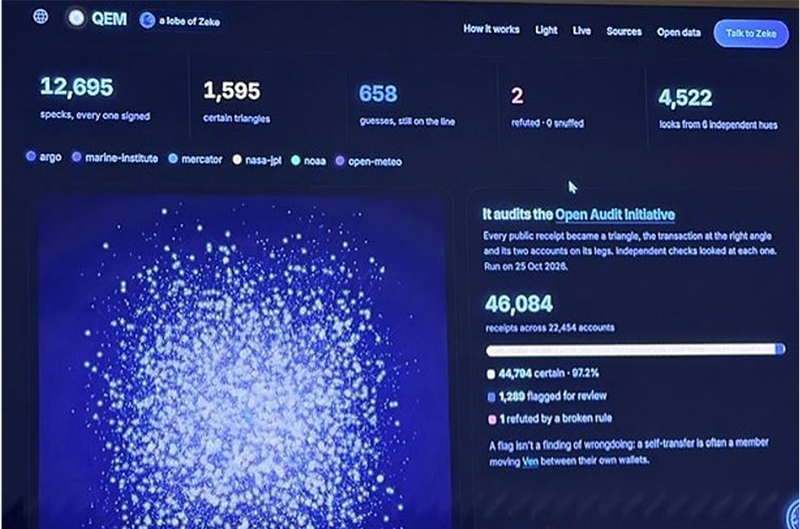
Bermuda based Hub Culture announced the launch of its Open Data Initiative [ODI]. The programme is ‘open source’ available to the public to view and add data. It was launched in Beta version three weeks ago with an initial report released for COP31. It is based on Hub Cultures Quantum Emergence Model [QEM]. The system can absorb large data files and rapidly ingest them, based on quantum analytics. Reports are issue weekly after a rigorous cross verification of the input data. QEM triangulates data and compares to related data to determine validity. Data classification moves from shades of ash through hues to move to radiance at the highest state of data clarity. The visual is eight dimensions.
ODI is tapping data from a variety of ocean sensors from the East Coast and added data off Africa earlier this week. Tide gauges, weather buoys and Argo floats data are weighed against an ocean model, hour by hour, to see which readings independent sources confirm and which are still open. Usable resources are added via an API to import data into analysis as well as to share data from the system. Data source is being confirmed by AI. Ocean Climate Fund Ocean Data
Open-Meteo’s sea temperature comes from the Copernicus Marine Service’s global model. It can identify which reefs are in the most trouble due to temperature rises. The points from La Parguera, Puerto Rico has moved to Bleaching Alert Level 1 after the temperature rose 5.4 °C in two weeks vs +1.6 °C par normal. The NOAA Reef Watch and NOAA AOML’s Alternative Floating Algae Index [AFAI] are data points tracked in ODI. The system is also monitoring Sargassum and plastics. For ocean plastics there published studies by NOAA NCEI microplastics samples from around the Atlantic. Those studies cite where and when each sample was taken, such as at the sea surface, in the water column, on beaches or, in sediment, as well what was found.
Screen print of the Ocean Climate Fund ODI QEM data page with an eight dimensional visual
The Ocean Climate Fund is focused on three objectives, the ODI, Blue Living Carbon, and Blue Circular Economy. Under the ODI, the Fund is working on research into low cost data sensors and sensor systems that can provide reliable ongoing ocean data in Goa, India and the Caribbean. The Ocean Climate Fund has partnered with Future Caribbean to fund a development prize for Caribbean startups focused on ocean issues. It has received 236 team applications from 39 countries.
The Blue Living Carbon for developing best practices for Marine Protected Areas [MPA], to build a global plan for marine protected area projects, as well as to develop shared and exportable governance, common legal frameworks, and other best practices. These include healthy habits for protecting phytoplankton. It is the most carbon absorbent, more than forests. It is dying from heat and creating dead zones in the ocean. The ocean cycle is on a 40 year reaction to what we have done. Absorbing the bulk of the carbon and it is reaching a limit. This is prompting a potential die off event for the ocean, very serious.
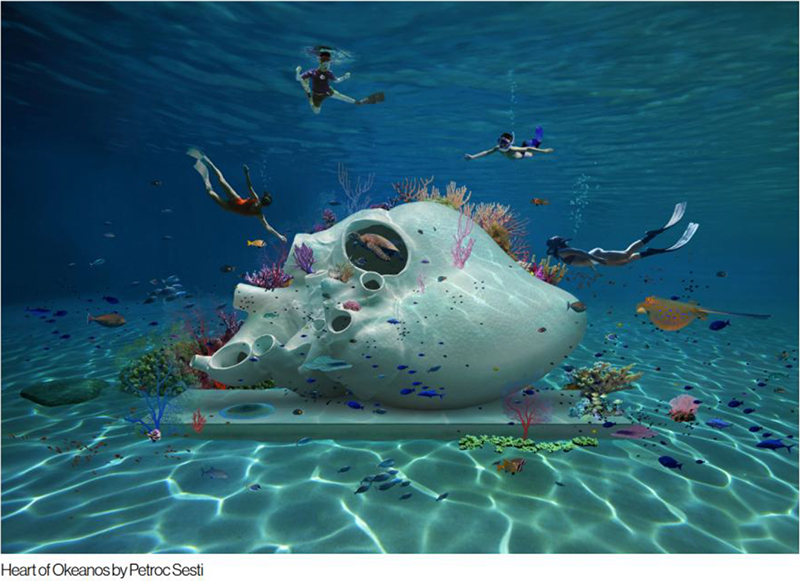
The Blue Circular Economy has funded the development of the ReefTile. The ceramic tiles are made in Miami. The reef tiles are art and create ocean sea walls for living reach. Will be making an installation in Bermuda next year. The ReefTile is a technology that enables seawalls to become living reefs. ReefTiles attach to a seawall or ocean floor, where they can host biodiversity and become an anchor point for coral growth.
The Bermuda Standard was initially launched in 2017 and is applying the new QEM for planetary climate data. It provides macro climate data. It has data source from climate.json including NOAA and NASA. Bermuda Standard is an open data repository for ocean focused intelligence gathering. There are113,669 readings and records to date with 81% confirmed by an independent source. The Standard has a new section on measures of climate pressures on land and sea, including mining and waste. ‘Where is the dirtiest place on earth,” Stalkner asked. The Bermuda Standard is based in Bermuda due to a tether to the Commonwealth legal basis applicable in many jurisdictions globally.
- Patrice Horner, Special Climate Reports at COP31


Read More About
Category: All


