
Column: Horner On Climate Change & More
[Column written by Patrice Horner]
“Security is the most important thing in life. We have taken it for granted for too many years. Now it’s back with a vengeance”, noted Zuzanna Rudzińska-Bluszcz, 2026 Yale World Fellow, former Deputy Minister of Justice of Poland as she opened the dialog on ‘The New Security Agenda during the New Climate Week last month. It was sponsored by the National Wildlife Foundation and The ClientEarth Team. The thrust was that nature and climate need to be added to the UN Security Committee.
Poland Minister of Climate and Environment Krzysztof Bolesta
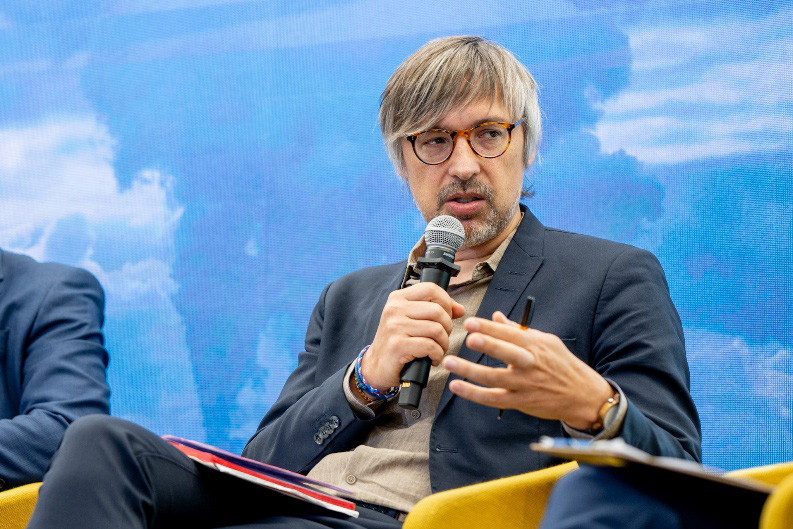
More clever and innovative solutions should be sought. Poland spent $25 billion from energy imports last year. Home grown energy solutions are a must for security, explained Poland’s Minister Krzysztof Bolesta, Secretary of State, Ministry of Climate and Environment. Europe is investing massively in defense. 50% of it will be via nature. Poland is reinforcing a 30 km dense forest and undergrowth along the northern border. Overgrowth destroys small road. Biodiversity is the big green shield.
Belgium has passed a decree to protect nature. Nature is now a primary risk. The planetary boundary and limits are sensitive. “Risking climate is tunnel vision” said Luc Bas, Director of Belgium’s CERAC [Climate Risk Assessment Centre] and Chief Planetary Officer.
Climate can be a scapegoat with everything blamed on it. 60% of nature has been destroyed. It happened unexpectedly fast. Vulnerable people not being protected. This could lead to social disruptions. Integrate climate and nature risk protections. Belgium is water stressed due to bad management. The social costs are tremendous without adaptation or mitigation. Take for example recent labor production losses, not to mention the health impacts.
Rachel Kyte UK Special Representative for Climate in the recent Client Earth Report
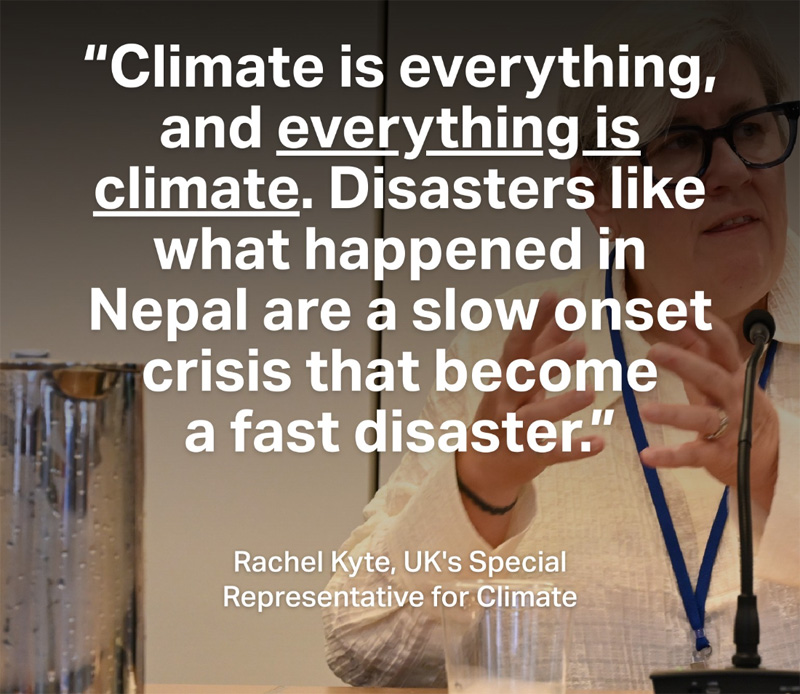
The UK has undertaken a security biodiversity loss assessment. They are examining the intricacies of the way things in nature interact and to see it via the lens of national security. “What might be the impact on national security, defence, domestic issues, and energy”, asked the UK Special Representative for Climate Rachel Kyte. “Everyone is being sideswiped by the climate crisis along with how to achieve security and the energy transition.” The world is now also under the pressure of the historic El Niño. The UK is determining who are the critical partners and how to work with them. In engaging with partners ahead of crises, they now recognize that the Congo nations are essential to food security. The Hydrological Flow from moisture in the Amazon Basin also has a direct effect on vegetables in the UK and EU.
In Brazil, climate change and nature related degradation is a security risk according to lona Szabó de Carvalho, Co-Founder and President of the Igarapé Institute. Some 80% of population are urban, subject to heat, water deluges, and mud slides. Nature acts as a security shield between it and Peru. Rivers are drying up, which were the traditional source of transportation in the Amazoon. The addition of roads will enable population movement, that opens regions that were otherwise protected from outsiders.
Dr Wojciech Modzelewski, Lawyer Public Finance, Energy Markets and Competition and lona Szabó de Carvalho, Co-Founder and President of the Igarapé Institute
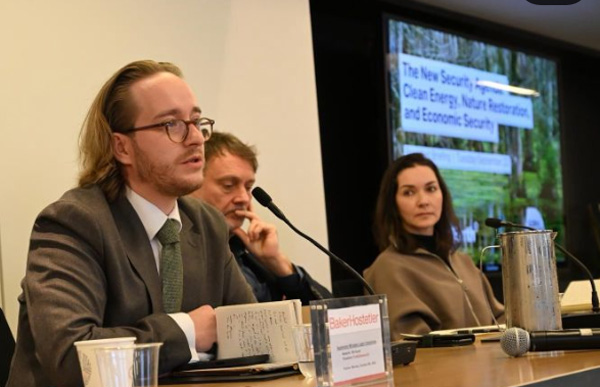
“Take into account in public policy and the recognition of security risks into law, for example the EU Nature Restoration Law,” explained Dr Wojciech Modzelewski, Lawyer Public Finance, Energy Markets and Competition. These laws and policies can add to protection of important infrastructure. Water wetlands are biodiversity shields as well as climate mitigators. Laws should encourage investments that aim to restore nature. There will be direct reductions in weather related damages. Create more diverse and renewable energy systems. This diversity protects energy availability and protects from energy crises in the future. EU Imports 90 billion tonnes of oil. Spills and sabotage are a real risk. ‘Manage fossil fuels better and implement workable policies. Modzelewski stressed, “Connect the dots between the military, nature, and energy.”
The UN General Assembly was also meeting during the New York Climate Week. Multinationals are not able to work with multi-crisis, especially with year-on-year impacts from climate and migration. There are also the big imponderables, such as removals and GS. The world’s climate is now in official overshoot of the 1.5 degree guardrail. The point is to integrate nature into the security picture and in the hunt for minerals and resources for defense. NATO has incorporated into their mandate the criticality of natural climates. With all that is happening globally, the UN cannot shy away. The panel called to add the environment into the UN Security Council mandate.
Remaking the UN for Peace and Security
“The very infrastructure of our life’s are underpinned by United Nations [UN]”. That’s why people with the UN General Assembly [UNGA] say, “talking is better than not talking”, noted Heather Gerken President of the Ford Foundation. The Ford Foundation and Project Syndicate hosted a series of panel discussions at the Ford Center for Social Justice during the 2026 UNGA, to address the direction of the UN at this pivotal moment. The goal is to explore how the United Nations can be reimagined for a rapidly changing world and to discuss the future of global governance.
Panel at the Ford Center for Social Justice during the New York Climate Week in late September.
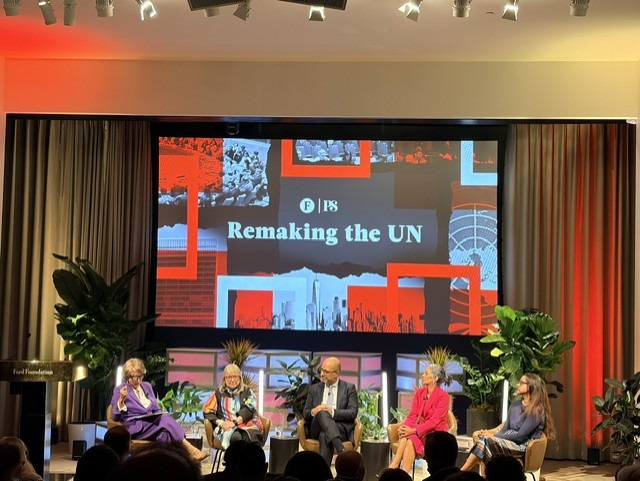
What can it do better? Is less more? These are the questions being asked of the 81 year old institution. The first UN General Assembly was held with 51 nations in London in 1946 before moving to Manhattan in 1951. Now there are 193. There is a need to prioritize the initiatives and the division of Labour, perhaps beyond the UN by working with the local service providing organizations. When the UN assistance shows up in a caravan of new jeeps, it is not received well by the locals. Dramatic cuts are affecting the vision for the UN and prompting it to change.
Peace and security should be its main purpose. The use of the veto in the Security Council has been an impediment but was required to bring the initial parties to the table. The veto now, by the US, Israel, and Russia, is opening the door to mass atrocities. There are other crises beyond geopolitical issues as well, such as increasing equality to minimize political risks to peace due to the growing economic divide.

The governing model of the UN is built for the few and not for the many. Now there are 193 bosses. It is the wrong premise to go back to basics, said one of the panel members. Continuity needs to be maintained. Peace keeping is not it’s current mandate however it is a core part of its Charter, “We the people of the UN are determined to save succeeding generation from the from the scourge of war”. Easier said than done.
Chapter VI of the UN Charter [Articles 33–38] sets out the framework for resolving international disputes peacefully, with the Security Council playing a facilitative role rather than imposing binding enforcement. Chapter VII, titled “Action with Respect to Threats to the Peace, Breaches of the Peace, and Acts of Aggression,” establishes the legal basis for the Security Council’s enforcement powers. It is the strongest and most coercive part of the UN Charter.
Member states revert to UN when there are no other choices. It does not act like a pressure release valve. The organization manages the secondary impacts slowly, when social media reacts quicker and incessantly. The UN action or inaction it can result in it becoming a scapegoat. Morale is low. There are 122k people working at the UN. They are encouraged to take calculated risk. Very few initiatives are prohibited. It may be better to simplify risks and unify the groups.
If radical change is not made, the UN will shrink dramatically as engagement lags along with the funding. The public wants a global institution that they can trust. The UN could be more of an equalizer in transitions, such as in Tech, AI, Energy, and Climate. These are security issues to the global population and to climate crises. They maybe better handled separately from the broad convening power of all the countries in the General Assembly.
The institutional discussion should focus on tangible outcomes, on what should be accomplished, rather than on arguments over where to put a comma. For climate change the Conference of Parties [COP] climate conferences are expensive to host and hundreds are flown in. There is a question of whether there have been substantial outcomes. There will be a new Secretary General of the UN in 2027, yet to be determined, so things will be changing.
- Patrice Horner


Read More About
Category: All, Environment


