
Column: Patrice Horner On Carbon & More
[Column written by Patrice Horner]
“We are generating 430 ppm [parts per million] of GHG [Greenhouse Gases], reaching a tipping point. Carbon capture is unavoidable.” Klaus Lacker PhD Emeritus at Arizona State University [ASU], pioneered carbon capture, carbon management, and true pricing. The focus must be on carbon reduction. It’s permanent once it enters the atmosphere. We emit 40 gigatons per year and growing, along with 10 gigatonnes of methane which transmutes into CO2. Removal should be at a factor of five or 200 gigatonnes. That is a lot of gases.
Dr Klaus Lackner PhD presenting at the CarbonTech Summit in NYC
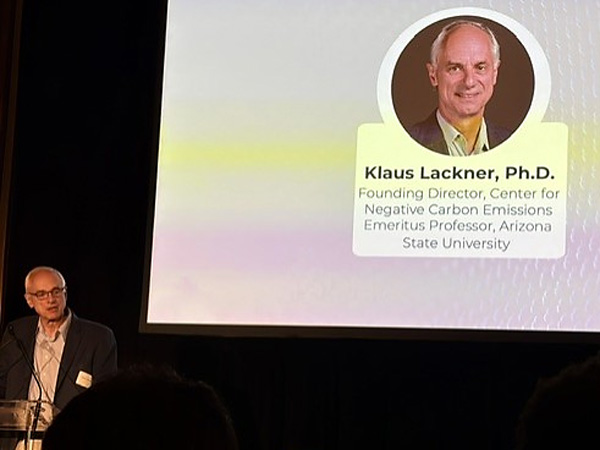
Storage is an issue for Carbon Capture and Storage [CCS]. According to Lacker, 300 yrs worth of storage would be required. A better approach for captured CO2 is to mineralize and use it in carbon materials or atomically restructured to create energy. This reuse has a value. CCS is 10x too expensive. It should be $30-40 a ton instead of $300, according to Lacker. The necessary scale to impact the atmosphere is cost prohibitive. It is difficult to scale projects up to 1 gigaton.
Carbon markets pricing are currently set on 20 yrs impact horizon. Voluntary Carbon Markets VCM investments were preloaded by technology companies and range in the price of $ 4–6 per ton of CO2. Whereas, the Mandatory Carbon Compliance markets are coming online with higher prices of $5–15 per ton of CO2. Now other carbon streams are being promoted, such as from waste or farms. Community GHG removal projects could help build momentum.
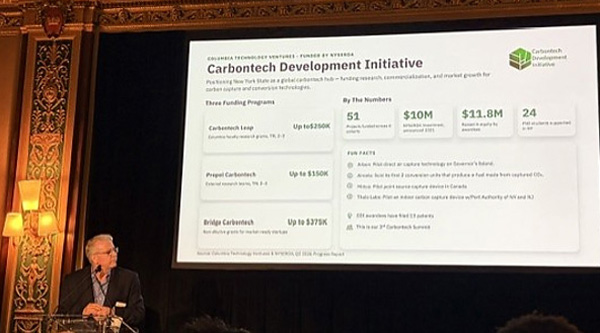
It is better to stick to smaller incremental concepts that can be reiterated in many locations. A short service life need be factored into the cost-benefit analysis, due to fast obsolescence in technology at this point. Dr Lacker points out that ‘At the end it’s a ‘waste management problem’. Coolants are also an issue, especially as more cooling required. There is leakage in all systems including energy generation and transportation. The Columbia CarbonTech Development Initiative [CDI] has a funding system to progress innovative technologies.
The Carbontech Summit at the 2026 NY Climate Week in September was co-hosted by Columbia Ventures-Carbon-to-Value and New York State Energy Research and Development Authority [NYSERDA] which has granted $96 million funding for innovative start-ups in New York. Worked with Holecene Carbon Removal to bring it to commercial scale. Google announced a new agreement to purchase carbon removal credits from direct air capture [DAC] provider Holocene, setting a record-low price for the technology at $100 per ton, with delivery expected by the early 2030s.
Overview of the Carbontech Development Initiative
The Ocean is the largest carbon capture system. The increased carbon levels negatively warming and increasing the ph or acid levels in the ocean, harming living creatures. Yet there are places in the ocean that can act as a natural filter of carbon. The cobalt flats in the Keruguelen Islands in the Indian Sea have been identified as a possible filtration zone by Dr Lacker and David Goldberg of Lamont Columbia University. They were working on ocean carbon capture and filtration through fissures where the earth’s crust undersea is ruptured. Or seamounts with certain geological compositions may serve as filters for CO2.
The CO2 is concentrated in the ocean at 2,700 meter of depth, according to Dr Lacker. The Bermuda seamounts range in depth of over 3,000 meters with some points reaching 4,650 meters. If the Carbon can be removed or reduced in the Oceans, it will draw more CO2 from the atmosphere and reducing the burden. If sinking liquified CO2 near such a filtration zone, it should be away from a so called ‘submersion zones’, where it would sink too low. If the filtered ocean is near an ‘upwell’ the recapture effect will be more rapid.
Learning The Earth With Artificial Intelligence & Physics [LEAP]
In his welcome, Pierre Gentine of Columbia University opened the LEAP panel with a deceptively simple concept that there are 5 steps in coding AI: Write, Translate, Analyze Data, Test hypothesis, then use AI Assisted Scientific discovery. The dynamic panel on “The Rise of Agentic AI: What It Means for Climate Innovation,” was at the Columbia Engineering Innovation Hub during NY Climate Week and elaborated on the somewhat more complex topic. The National Science Foundation funded the LEAP collaborative network led by Columbia.
It is a game changer that AI Agents or Agentics can analysing complex terabytes of data, then visualize it to minimize the biases in models in order to test hypotheses or theories. Weather Pipeline is a software architecture to collect, process, and analyze meteorological in Zephyrus, the LLM Agentic developed by UCSD for weather science. EarthLink is being use for testing climate with a full pipeline agents. Deepminds is being tapped to create new algorithms from scratch, which is a method for solving problems.
Google Research tests for climate mitigation and evolution. Ignacio Lopez Gomez of Google notes that the warming climate is changing water levels and temperatures at depths, impacting operational weather forecasts. Limited nonstationary data is not suited. It must be dynamic. Google Anti-gravity AI runs through ERA environmental software incrementally to isolate solutions. This resulted is lower forecast error. Humans can act as principal investigators with AI Agents accelerating co-development. This will enable more rapid climate adaptation, rapidly evolved and recalibrated.
Dr Kara Lamb of Columbia detailed Earth and Environment dynamic analysis. Parameterization of physical processes over the centuries takes time to convert or update code in the Earth System Models [ESM] and to verify with expensive iterations. Machine Learning ML models in JAX can anticipate complex dynamics in natural systems, such as ‘collision coalescence’ in rain formation know as ‘structural pathology’. Human intervention directs model selection and identification of Large Language Model LLM failures. They can ask AI to propose new models for high-fidelity match to the observed data. The data is moved into an Earth Turbulence Model in Fortran that is then converted to JAX code. There is a Draco Chamber at Brookhaven capable of undertaking such elaborate manipulations.
Sameer Mohamed is a Deep Learning Expert at AWS Generative Innovation. He said AI can handle more ambiguous models. Agentic started in 2024 as document processor combined with data ie fill in forms such as Smart Contracts. Model Context Protocol [MCP] has moved into task degeneration in 2025, so that the process steps can written in Agentic own code for recursive improvements. MCP is a bridge to see the relevant data on a company’s server. This is done in AI teams, working on separate sections concurrently. ‘Harnesses’ are the data Agents limits of what it can access for optimization.
Duncan Anderson of NVIDIA, Stephan Hoyer of Periodic Labs, and Sarika de Bruyn LEAP also contributed to the discussion. Human effort is the definitive step for what you are trying to achieve. Agentics spend ‘tokens’ as processes are taken. The ‘inference time scale’ in AI or science research is the time taken training and or learning autonomously. Humans monitor objectives and must focus on how the AI arrives as results. Large Language experts are required. High Value vs Low Value/Risk Table are guidance. Invest in Tool Quality and Data Layer transparency.
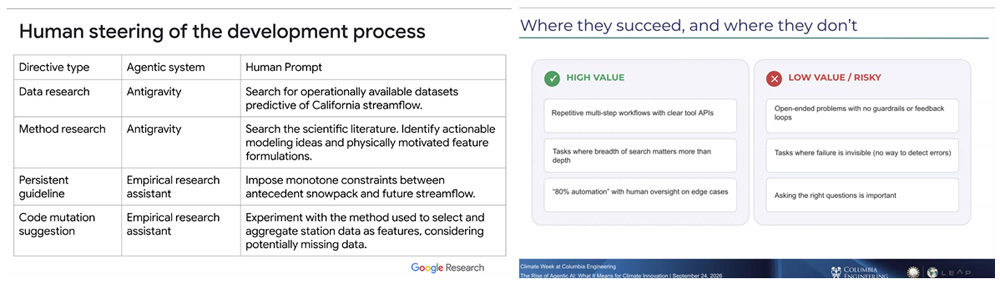
What is the role of human ingenuity? Agentics have problems defining hypotheses. To have better intuition and critical thinking people must be involved when AI is challenged to think outside of the initial hypothesis. We gain the ingenuity from experience. Will the people want to go through all the effort is the question. Climate science has been inaccessible outside the industry with Agentic translation levels. Now the Large Language Models can used more widely. Scientists have access to the whole tool box vs Deep Learning Model.
The open AI OSCAR Earth System Model is designed to simulate how the planet responds to human activity. The NASA OSCAR Project is a global database calculating ocean mixed-layer dynamics. The World Meteorological Organization WHO OSCAR TOOL has set standards for the meteorological data shared with the system. Organizations and Institutions are encouraged to collaborate on the OSCAR climate models to achieve large scale global climate solutions. Opensourceclimate.org
- Patrice Horner


Read More About
Category: All, Environment


