
Triumphs & Trials Of Cahow Nesting Season
[Written by Jean-Pierre Rouja]
The first half of the 2024/25 Cahow [Bermuda Petrel] nesting season on Nonsuch Island has proven to be one of the most dramatic and instructive in recent years. Thanks to Chief Terrestrial Conservation Officer / Nonsuch Island Warden Jeremy Madeiros’s ongoing management efforts supported by myself, Nonsuch Expeditions founder & CahowCam creator J-P Rouja, conservationists, researchers, and a global audience have been able to witness the intimate details of the Cahow’s breeding cycle, ranging from early courtship and egg-laying, and unexpected questions about chick paternity, to a remarkable rescue during a nest invasion by a white-tailed tropicbird. This summary brings together key events and insights from October 2024 through April 2025, highlighting the vital role of boots-on-the-ground conservation, cutting edge technology, and community engagement in the ongoing recovery of one of the world’s rarest seabirds.
Season Progress: Key Events and Developments
Early Season: Pairing, Egg Laying, and Incubation
October–November 2024: Return and Courtship
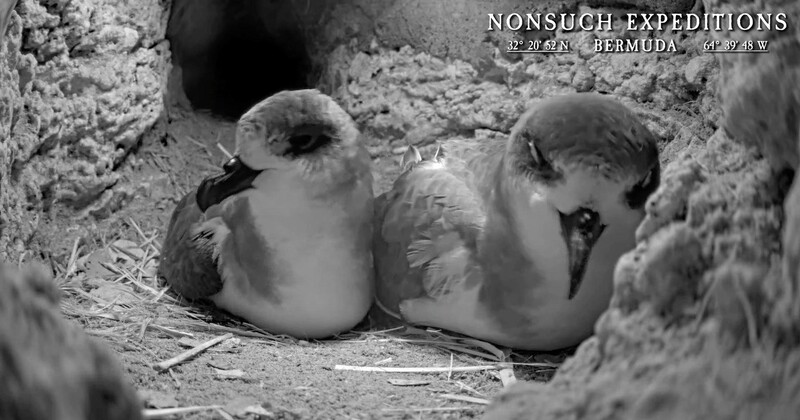
- Cahows returned to their burrows on Nonsuch Island in mid-October, following a trend of earlier start dates for their 2024/25 nesting season, and the beginning of the 14th year of continuous live-streaming from the CahowCam systems.
- The returning birds engaged in nest building, courtship, and mating after spending five months apart at sea. This period is crucial for pair bonding and preparing the nest for the upcoming breeding attempt.
- This season the Cams allowed the team to document for the first time mating activity between the resident female and a male Cahow from another nest, leading to paternity questions for this thought to be monogamous species, which the team is addressing as part of Genomic population study with project partner BioQuest.
- After several weeks, the pairs departed out to sea for their pre-egg-laying exodus in December. During this time, females develop their single egg, while males build up fat reserves to sustain them through the initial long incubation shift.
January 2025: Egg Laying and Incubation
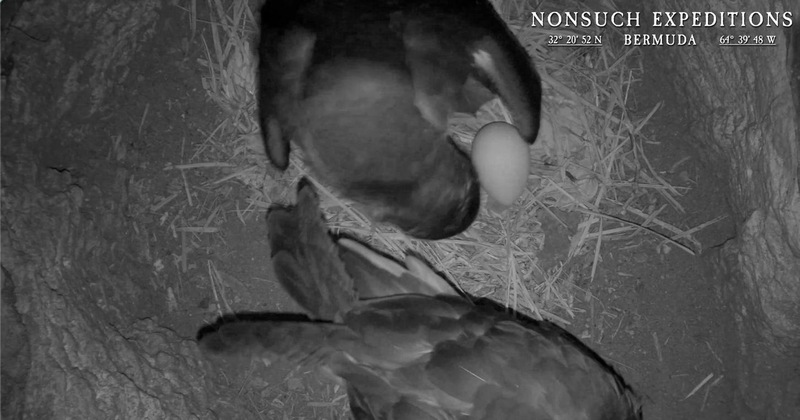
- The pairs returned in early January with the females typically laying their single egg within hours of returning, and the male taking on the first long incubation shift whilst she goes back to sea to recharge.
- In CahowCam 1 [nest R831], the male returned at 3am on January 7th, followed by the female at 7pm. She laid her egg by 8:11pm that same evening.
- In CahowCam 2 [nest R832], the male “Sampson” returned around January 10th. His new mate [after the previous long-term mate failed to return in 2023] arrived quite late on January 17th and laid a larger-than-average egg, also within hours.
Late January–February 2025: Egg Development and Setbacks
- The CahowCam 1 egg was confirmed fertile but unfortunately developed a large “dimple” crack. Despite efforts by the team to help save it [using a field-tested coat of nail polish to help seal it], the embryo failed by January 26th, continuing this pair’s pattern of successfully producing a chick every other year.
- In contrast, the CahowCam 2 egg was fertile and developing normally, bringing hope for a successful hatch.
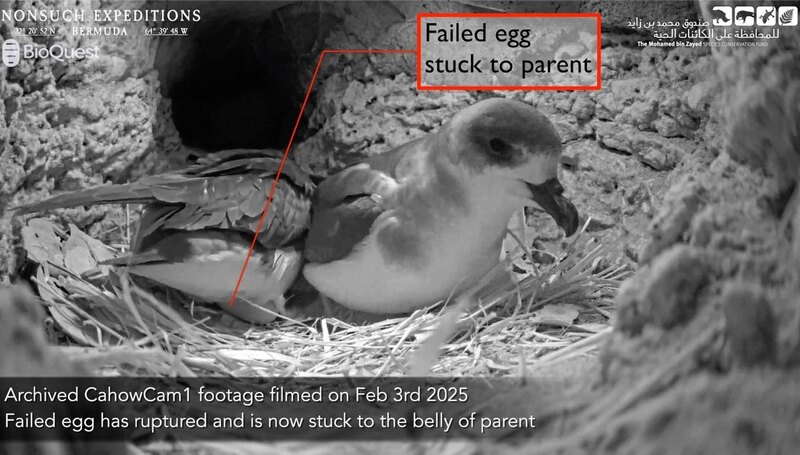
- The failed CahowCam 1 egg continued to be incubated until early February, when, having partially ruptured, was observed stuck to the incubating parent’s belly feathers and eventually disappeared after the parent returned from a feeding trip out at sea.
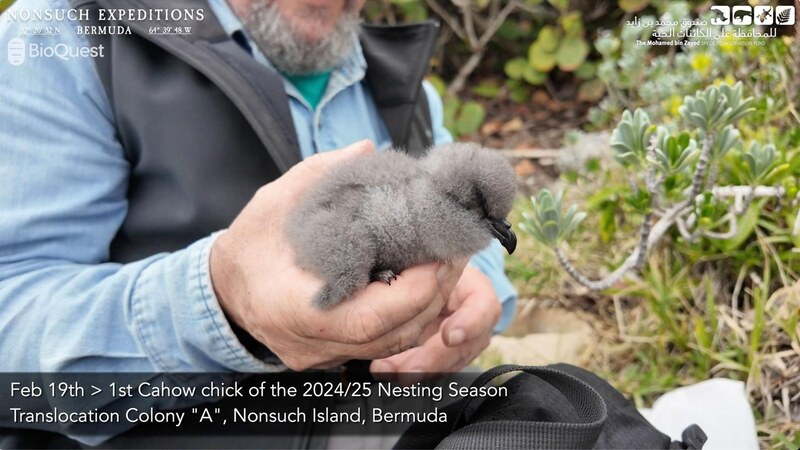
- Elsewhere in the Colony the earliest Cahow chick on record was documented on March 15th.
Hatching Success and a Dramatic Nest Invasion
March 2025: Hatching Success
- On March 5th Jeremy confirmed that the CahowCam 2 egg had “dimples” [the chick makes dents in the egg, as it starts to break through the shell].
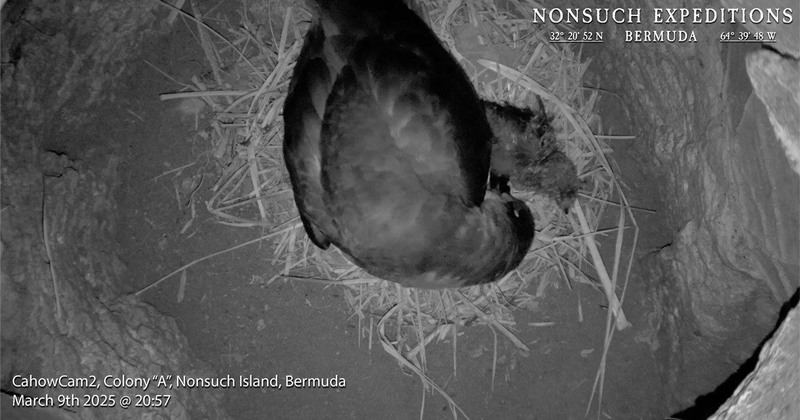
- By March 9th at 5:30 AM, the CahowCam 2 camera revealed the first “pips” [small holes in the egg as it starts to break out] which progressively became larger throughout the day until the chick successfully hatched at 8:55 pm, a significant milestone for the new pair and for the season overall.
- The live cameras captured these rare and intimate moments, providing invaluable footage for scientists, students, and global followers.
Late March: The Tropicbird Incident
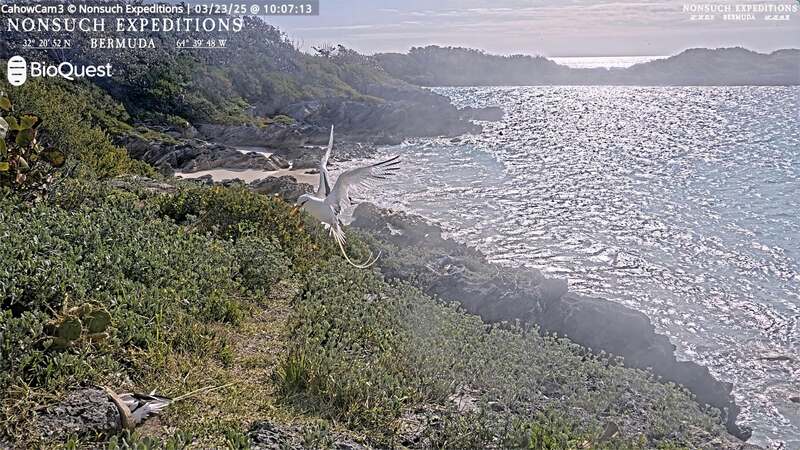
- A major crisis unfolded in late March, when the CahowCam 2 nest was invaded by a white-tailed tropicbird [longtail], a known competitor for nesting sites.
- Over the past 14 years, the CahowCams have enabled real-time monitoring of the Cahows, allowing conservationists and a global community of volunteers to observe and log rare behaviors and threats.
- This season, increased visits by prospecting Cahows and other species raised concerns about nest competition, especially as the growing Cahow population outpaces the availability of new burrows.
- Historically, tropicbirds used to kill up two thirds of the Cahow chicks each season until Jeremy’s predecessor David Wingate started using wooden baffles with a hole through which Cahows can barely fit, but larger, differently shaped tropicbirds can’t.
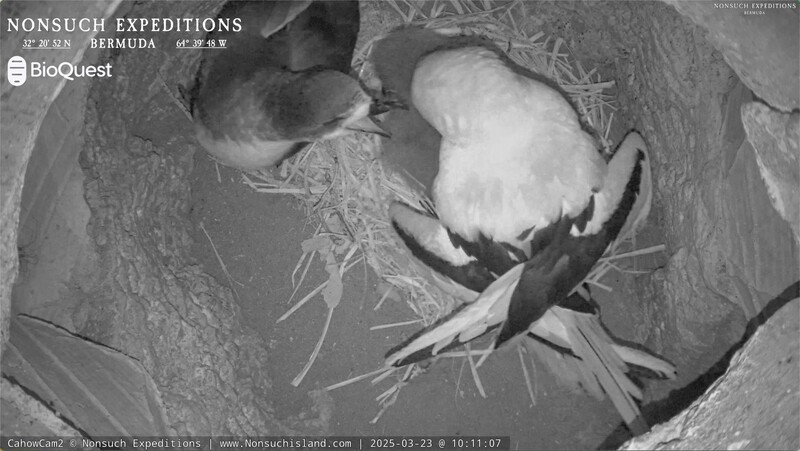
- On the morning of March 21st, a smaller than usual prospecting tropicbird squeezed through the baffle and entered the CahowCam 2 burrow, fought with a visiting prospecting adult Cahow, and began harassing the chick. The smaller Cahow, later identified as “Zephyr” [a female that had fledged from the same nest in 2020], bravely defended the chick before being driven into the tunnel.
- Thanks to an alert from the CahowCam livestream, conservation officer Jeremy Madeiros raced to the island, arriving in under an hour just in time to extract the tropicbird, saving the chick from almost certain death.
- The adult Cahow “Zephyr” was relocated to a new empty burrow, and additional deterrents [such as scurvy grass mounds] were placed at the nest entrance to hide it from prospecting tropicbirds flying past, to reduce future invasions.
Behavioral Insights and Conservation Challenges
Parental Care and Competition
- The CahowCam livestreams have documented not only parental care but also aggressive interactions among prospecting Cahows and questions about chick paternity, now the subject of ongoing genomics research with BioQuest.
- The cameras have also revealed that after egg failure, adults may continue to incubate for weeks, and that prospecting birds sometimes attempt to brood or even mate in occupied nests.
- Pairs with failed eggs depart early and spend more time at sea, returning heavier and in better health for the subsequent season.
Nest Site Competition and Population Recovery
- The ongoing recovery of the Cahow population—now over 165 pairs, up from just 17 in the 1950s—has created new challenges as nest site competition intensifies, not only among Cahows but also with other seabird species like the tropicbird.
- The live-streamed footage has been invaluable in identifying and responding to these threats in real time, as demonstrated by the rapid intervention during the tropicbird invasion.
The CahowCam Project: Technology at the Heart of Conservation
Technical Innovation
- The CahowCam Project, now in its 14th season of livestreaming, has revolutionized seabird conservation and public engagement.
- Custom-built, solar-powered, and waterproof infrared cameras are installed in manmade burrows, streaming live, high-definition footage 24/7 without disturbing the birds.
- The system uses military-grade infrared LEDs invisible to the Cahows, allowing natural behavior to be observed even in pitch darkness.
- The cameras are modular, remotely controllable, and energy-efficient, with a robust wireless network enabling real-time global access.
- The system was designed and built by Nonsuch Expeditions Founder J-P Rouja, who is in discussions for replicating it elsewhere.
- The Nonsuch Expeditions team is also field-testing an AI assisted rodent detection system with the Nature Conservancy, as part of its mandate to develop Conservation Technologies.
Global Engagement and Rapid Response
- Over the past 14 years millions of minutes of Live and Archival CahowCam footage have been watched, attracting hundreds of thousands of viewers, and has become a vital tool for both research and rapid response to threats like the recent tropicbird invasion.
- The CahowCam partnership with the Cornell Lab of Ornithology helped expanded its reach and impact, making the secret lives of this “Lazarus species” accessible to a worldwide audience, however this partnership is now over and new partners and sponsors are being sought.
- Real-time monitoring has enabled immediate interventions, such as the rescue during the tropicbird invasion, and has become a vital tool for both research and education.
Looking Ahead
- The newly hatched chick in CahowCam 2 will be monitored through fledging, expected in late May to early June.
- The live CahowCams remain a critical tool for research, education, and public engagement, documenting the ongoing recovery of one of the world’s rarest seabirds.
- As the season continues, the story of the Cahow remains one of resilience, innovation, and the ongoing struggle to secure a future for Bermuda’s national bird.
Conclusion
The 2024/25 Cahow nesting season on Nonsuch Island has been a testament to the power of technology, community vigilance, and dedicated conservation. While CahowCam 1 experienced egg failure, CahowCam 2’s successful hatch—and the dramatic rescue of its chick—offer hope and underscore the importance of ongoing efforts. The season has highlighted both the fragility and resilience of the Cahow, one of the world’s rarest seabirds, and the critical role that innovation plays in its ongoing recovery. As the fledging period approaches, the world continues to watch, learn, and support the remarkable comeback of Bermuda’s national bird.
To learn more and sign up for our Newsletter and Tour notification visit: www.nonsuchisland.com.



Read More About
Category: All, Environment


