
Gil Hanse Discusses Mid Ocean Restoration
World-renowned golf course architect Gil Hanse discussed plans to restore the historic Mid Ocean Club course, highlighting its original design, iconic 5th hole and his vision for returning it to Charles Blair Macdonald’s intent.
A spokesperson said, “World renowned golf course architect Gil Hanse has been appointed to oversee the restoration of Mid Ocean Club, Bermuda, the only Charles Blair Macdonald course outside the United States.
“In this Q&A interview, Hanse explains why the oceanside layout is among Macdonald’s finest, why the 5th hole is ‘one of the greatest holes in golf’ and how he plans to restore the century-old course to its historic best.”
When asked, “What is the vision for the restoration of Mid Ocean Club?”
Mr. Hanse said, “The vision always in our minds comes down to, first and foremost, restoration. It’s about trying to understand what Charles Blair Macdonald and Seth Raynor built, how things have changed over time, and then do the best we can from a research standpoint to try to get it back to the original vision.
“Thankfully, the club had a lot of historical information and so that made our job much easier. We’ve had the good fortune of being entrusted at other Macdonald and Raynor golf courses, so we felt with that background and the specific information about Mid Ocean Club, we were going to be well prepared to present a plan to the membership to restore the golf course back to the original Macdonald and Rayner vision.”
When asked, “Tell us about Charles Blair Macdonald and his ‘template’ approach to creating ideal golf holes – and how it was applied at Mid Ocean Club?”
Mr. Hanse said, “Charles Blair Macdonald’s resume is actually fairly short, but every single golf course that he ever worked on was impactful, not only from the standpoint of that particular club, but in the world of golf course architecture.
“He set out to build the monument for American golf architecture at National Golf Links of America. And from there he continued to build these amazing golf courses. Now, to a certain degree, he believed that there was the ideal golf course – and that’s the way he put it – and that it was constituted from certain holes and certain concepts that he believed were an important part of creating the link of all 18 holes.
“So you have the template holes that everyone knows about: the Redan, Punchbowl, Biarritz, etc. And then he tried to incorporate those in different settings. That might make his work sound almost repetitive and that you would expect to see the same thing over and over again. But what he was so brilliant about, and certainly Seth Raynor, his lieutenant, is incorporating those concepts and those ideal golf holes into different settings. So when you think about a Cape hole at Fishers Island versus the 5th hole at Mid Ocean Club, they’re very, very different from an elevation standpoint. The concept, the construct is exactly the same, philosophically; but the presentation, the way it sits in that different landscape is what ultimately sets it apart and creates the brilliance of his work.
“At Mid Ocean Club, we saw him understanding the scale and the scope of the property. Obviously, whenever you can put your golf holes up alongside an ocean, you’ve got a significant scale for the horizon line. And then the ability to put it where you can actually see the surf crashing up against the rocks is another beautiful aspect of what happened at Mid Ocean Club.
“I think people tend to think of seaside golf courses as being fairly flat, and that’s the surprising thing. I hadn’t been to Mid Ocean Club in almost 35 years from the time that I was there with my wife, Tracey, on our honeymoon. So, coming back to see the golf course, I was really struck by the elevation change and the topography on the golf course was significant.
“I think Macdonald incorporated those template holes and created that ideal golf course in a landscape that was so very different than almost anything else he had worked on. And the relationship between land and sea there is a completely different aspect than where he had been given the opportunity at places like National Golf Links or Lido – or Seth Raynor at Fishers Island. And so from that standpoint, I think it’s a truly special blending of that vision of ideal golf holes with a wonderfully unique canvas to work upon.”
When asked, “Why is the 5th hole regarded as one of the greatest holes in golf – and how do you plan to restore it?”
Mr. Hanse said, “The 5th hole at Mid Ocean Club is recognized as one of the greatest holes in the world of golf, and appropriately so.
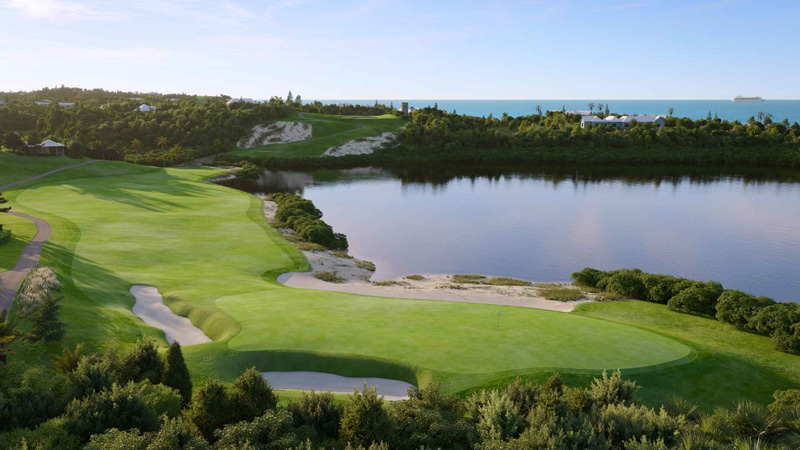
“It’s the most audacious and interesting version of the Cape hole, where the theory is to take off as much as you can chew to gain an advantage. It starts off at this elevated tee looking down over Mangrove Lake. When you look at the original design and the scale of it, and without the mangroves lining the lake, you were able to take in the breadth of the hole and really understand what Macdonald was asking you to do.
“And so it’s about the restoration of the lake edge and restoring the dramatic nature of the golf hole and connecting golf back to Mangrove Lake which, over time and evolution, it had become separated from. I think, ultimately, we’re looking at that restoration as being the high point, not only from a visual standpoint, but also from a design standpoint and restoring the tee shot.
“From the fairway you are in a position to play up into the elevated green, and we will be expanding that green, restoring bunkers back to the original scale and scope to match the beauty of the tee shot. So, I think all in all, it’s just getting the scale of that golf hole back into the original design concepts.
“It is certainly bold: an elevated tee shot, carry over water, an exciting green. Maybe even a bit audacious, if you think about it in that term. Given the day when that golf course and that hole was built, it was a monumental challenge to overcome, hitting off of that from that perch. It is rightfully regarded as one of the greatest holes in golf.”
When asked, “What is a restoration versus a renovation?”
Mr. Hanse said, “With the restoration of golf courses, we believe very strongly that the original design intent, both from the standpoint of the strategy and the presentation, the way it sits visually in the landscape, we take all of our cues from restoration from the original architect. So, there are very few inputs from our standpoint.
“Whereas, with renovation, it’s a shared landscape. You’re taking ideas in the original design and you’re incorporating significant input from us. And we’ve always believed whether it be working at a Macdonald-Raynor golf course, or Donald Ross, Alister Mackenzie, A.W. Tillinghast, first and foremost, we should take our cues from that original architect. And when you’ve got a great golf course like Mid Ocean Club, we believe it’s our responsibility, number one, to protect and preserve and do the best we can to bring their design back.
“It’s also just something that we enjoy. We thoroughly enjoy the challenge of doing the research, getting the homework in and trying to be as specific as we possibly can. This is the end game when it comes to any restoration; we want to present a golf course where the vision, when we leave that property, is as close to the original vision as possible. And the membership that exists today is seeing that golf course just close to the original design, as any generation of members since the original group. If we’re successful in doing that, painting that picture, then we believe that that restoration is a success.”
When asked, “How have members’ photographs of the course aided your research?”
Mr. Hanse said, “We’ve been very lucky that we’ve had some great information and some archival footage. We’ve got great aerial photographs. Macdonald-Raynor plans don’t really exist. For whatever reason, they’ve been lost over time. Raynor being an engineer, you’d think they’d have much more detailed plans. But they really didn’t do that, and I think they just relied more on sort of the initial concept and then fitting the ideal golf holes into the landscape around them. So I don’t think a lot of detailed plans exist.
“But the one thing that we have had, which is great – and you tend to find this at great old clubs that have long legacies of membership and family engagement – is we’ve actually had some members come forward with photographs of their grandparents playing golf out there. We actually had one member who provided us with photographs of Charles Blair Macdonald playing golf out there with one of his family members.
“And so we have had a wealth of information that we normally don’t get access to. It was well chronicled as a famous golf course when it opened; and certainly Macdonald was very good at promoting his projects. We’ve got some photographs from during construction, we’ve got the great aerial photos, and then having some of these family heirlooms has been a treasure trove of information. We feel like we’re armed with a lot of great stuff as we move into this restoration.”
When asked, “Tell us about your personal connection to Mid Ocean Club?”
Mr. Hanse said, “The first time I ever arrived at Mid Ocean Club was on our honeymoon. We’re going to be married for 40 years this year. So, 40 years ago, we stayed out at Cambridge Beaches on the far end of the island. And I knew of Mid Ocean Club. I’d read about it, heard about it.
“And, my very understanding wife, Tracey, decided it would be okay if I took a day and went and played golf. So I went over and played the golf course and fell thoroughly head over heels in love with it. But with time and family and work, I hadn’t returned to Bermuda for about 35 years. And so when we were given the call to come and look at doing the restoration of the golf course, it became one of those, well, let’s go interview, because it would be really great to go back to Bermuda for the first time.
“And so having that personal history has been wonderful. On one of the visits to collect information for the site plan, Tracey and I did go back out to Cambridge Beaches. We had dinner. So having that relationship and that history with the island has been a special part of this. And, during construction, I’m sure Tracey and I will, will avail ourselves of that opportunity to get back out there again.
“Bermuda is a special place in my life. I always remember my Mom talking about Bermuda being one of her favorite places in the world to go to, and I think that may be why we went there for our honeymoon. And, yeah, that connection is really, really special for us.”
When asked, “What are your feelings about the opportunity to restore another great Charles Blair Macdonald golf course?”
Mr. Hanse said, “For the membership, we’re really excited about this opportunity. C.B. Macdonald only built 10 or 12 golf courses, depending on how many you want to count and give him credit to. The fact we now have a significant opportunity at Mid Ocean Club means the world to us. He is on my personal Mount Rushmore of golf architects. Ultimately our goal is to be faithful to his work and to restore his work.
“We are excited to get into these greens and really do some forensic work and try to figure out exactly where contours existed. Ultimately, having presence on site, being on the machinery myself, will give us an opportunity to really kind of get in the ground and figure out what he built. It will be really nice to get in the ground and faithfully restore what he built on that property.
“So it’s an honor for us to have the opportunity to work on another C.B. Macdonald golf course. And it’s our expectation that when we’re finished, this membership will see the golf course through the lens that he saw it through, and that will be a wonderful success for us.”



