
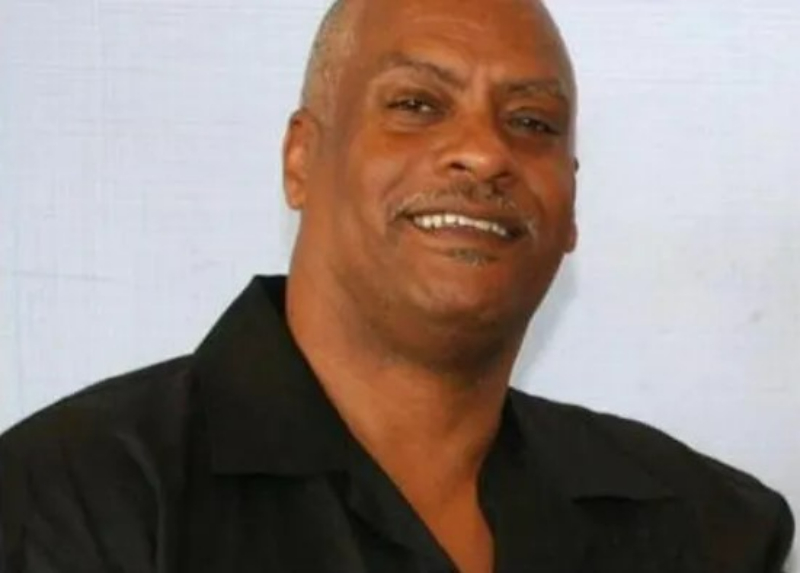
Russ Ford Remembered For Life Of Service
[Written by Patrick Bean]
Muhammad Ali once said, “Service to others is the rent you pay for your room here on earth.”
Russ Ford not only heard this from the lips of the former undisputed heavyweight boxing champion; he took the message to heart.
Named “Nurse of the Year” by the Bermuda Nurses Association in 2005, Ford’s adult life was described as “an act of continuous, unyielding benevolence, embodying true servant leadership”.
He embraced his duty to offer help and compassion to those who had little, and the nurse, probation officer and magnanimous force for good recently died after a long battle with health complications stemming from injuries suffered in a fall accident.
During the 1980s, Ford battled on the front lines against two flashpoints that adversely affected Bermudian society, the spread of HIV/AIDS and a burgeoning crack cocaine epidemic.
While many, even medical professionals, were paralysed by a false fear of contracting the virus from sufferers, and society shunned them, Ford strolled fearlessly among the downtrodden, offering comfort, respect and necessary aid to the afflicted.
In 1984, Ford was seconded to Addiction Services on Victoria Street, Bermuda’s first dedicated outpatient drug treatment facility.
While working there as a nurse, he met Llewellyn Gomes, Rev Dr Carolyn Armstrong, and Christine Atcheson. A bond formed, and the quartet became lifelong friends and comrades-in-arms in the fight against a dual scourge on humanity.
“In 1984 two big things were happening in the community, AIDS and the crack cocaine epidemic,” explained Gomes, a former addict who had recovered to become one of the drug counsellors employed at the facility initiated by Bryant Richards. “Basically, his assignment was to dispense medication for methadone patients.
“Bryant Richards had set up Addiction Services, but he entrusted us with full control of the facility, which required a nurse and a psychiatrist. Russ came on board as the nurse, but he went above and beyond his remit.
“He was, to me, highly motivated, had a lot of energy and was brilliant when it came to medicine. He knew that for the place to be successful and to help people in a truly significant way, he had to get involved above and beyond what he was hired to do.”
Gomes told of how the pair initiated drug education programmes within local schools, the prison system as well as at Addiction Services, employing clinical and holistic models discovered overseas.
Nevertheless, Ford wanted to do more and, with Atcheson and Armstrong, he laid plans for the advent of STAR, Supportive Therapy for Persons with AIDS and their families, to provide comprehensive support to persons infected and affected by HIV/AIDS.
A single Monday-night meeting in 1986 became the seed of everything Ford would build, and eventually hand to others.
As Armstrong remembered, she was invited to meet Ford and Christine Atcheson at Addiction Services. Strangers became friends that night, and Armstrong noted how she sat and listened, awestruck, as Atcheson and Ford described the plight afflicting Bermuda.
“The night we met, I was in awe because these two people presented to strangers the fronts they’d seen our country encounter,” said Armstrong. “This man spoke with such compassion.
“And not only did he speak with compassion, but there was conviction. I felt that they were sharing that men and women were dying, and at that point men in the country were dying of this very devastating disease of which much was unknown.
“But the way he shared it with such passion. He was speaking of men that he had been working with at Addiction Services.
“It was at that meeting that the STAR Charity was formed, and Russ gave us the acronym Supportive Therapy for AIDS Victims and Their Relatives.
“Compassion grows. Compassion is something that increases. And thus, compassion increased every time he presented to us.”
Such was Ford’s empathy for those burdened with HIV/AIDS that he suggested the organisation revisit the name and replace the term “victims” with “friends”, to remove negative stigmas that some might attach.
He also mandated that the STAR team not wear badges signifying their association while visiting hospital patients so as not to disclose diagnosis, but to preserve patients’ right to privacy.
“Russ did not want us to see them as victims,” said Armstrong. “Russ always wanted to see flesh and blood. He wanted us to see warm-blooded people whose plight was untimely death.
“They had the right to dignity and respect.”
With Ford as its conductor, STAR’s reputation grew exponentially, as did its impact in spreading greater awareness of the true nature of the disease and those afflicted.
“Russ’s personality drew many people to STAR,” continued Armstrong. “We built this band of volunteers. And every Monday night, he would call us all together.
“He set up meetings every Monday evening at Addiction Services where we would meet to talk about what we were experiencing.
“But not only that. Families were invited. As families were invited, Russ began to share with us how to reach out to them, how to sit and observe a mother, a father, a wife, as they watched their loved one, their significant other, transition from robust to a shell of a person before death.
“He taught us one thing I will never forget. He said, ‘You transfer what you’re learning, what you know. Transfer that eighteen inches to your heart’.
“Those are some of the things that I can say have helped build and sustain me. Things that help me to consider every day whether or not I have accomplished that which the Lord has set me into the earth to accomplish.”
STAR, however, was not the end of Ford’s labour among the needy, as he would pivot away from STAR to aid in the establishment of Agape House to provide “compassionate end-of-life care for patients and support for their families”, particularly those suffering from HIV/AIDS.
As both a caregiver and builder, Ford had seen the gap in care for HIV/AIDS patients and the dying, and helped create the island’s first hospice to fill it.
In later years, Ford became a fixture within the court system.
Leslie Grant, Executive Director of Focus Counselling Services, noted Ford as an advocate who met people where they were…
He reflected on his industry counterpart’s work with the underserved, drawing chiefly on his firsthand experience with him as a corrections nurse and, later, as a case manager with the Department of Court Services.
“Russ was a champion for the underserved and unheard,” said Grant. “Definitely, as far as the prisons go, he ensured that folks who needed support coming into prison, whether it be mental health or addiction, had what they needed or access to services they could benefit from.
“Outside of corrections and mostly in his role as a case manager with the Department of Court Services, he was definitely an advocate.
“One can’t say that enough for those that may be underserved or have a harder time getting access to services or navigating services.
“I know personally that Russ went out of his way to ensure the people he worked with had access to whatever services they needed, and to other supports he may not have had access to himself.
“He was a champion for the underserved and unheard who will be remembered across two settings where access to help is hardest to find.”
Anthony Tuzo was one of those who personally benefited from Ford’s efforts and he praised Ford for helping him navigate moments of despair.
“Mr Ford was a real dedicated man,” said Tuzo. “I have much respect for him, having treated me with courtesy and respect … like I was a normal person rather than a criminal or addict.
“He would really look out for me. He would give me legitimate work from time to time and show me how to do better.
“In the court system, my mom and I used to go to court, and he would help direct me and ensure I was following what I was supposed to do to help in my recovery.
“He encouraged me to live better and do better. He showed me that someone cared and that I needed to care for myself better.
“He was a good man and will be missed a lot.”


