
Eco Lunch & Learn On Coral Reefs On Feb 26
The public is invited to a free lecture on coral reefs presented by Yvonne Sawall on Thursday [Feb 26], hosted by the Bermuda Environmental Sustainability Taskforce [BEST] and Bermuda College.
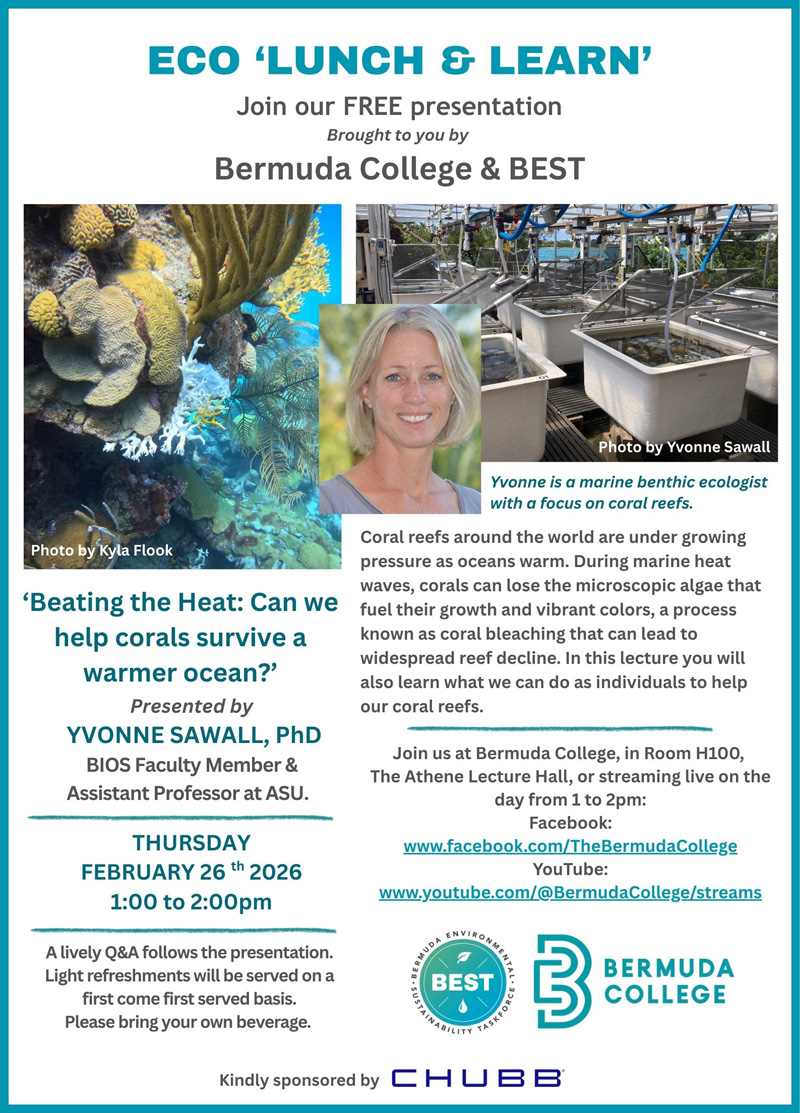
A spokesperson said, “The community are invited to attend a free lecture on Thursday, February 26th, to learn more about coral reefs in this presentation, ‘Beating the Heat: Can we help corals survive a warmer ocean’. The lecture is a free presentation of Bermuda Environmental Sustainability Taskforce and Bermuda College and marks the first lecture in their Winter series for 2026.
“Coral reefs around the world are under growing pressure as oceans warm. During marine heat waves, corals can lose the microscopic algae that fuel their growth and vibrant colours, a process known as coral bleaching that can lead to widespread reef decline. In this lecture, you will also learn what we can do as individuals to help our coral reefs.
“Yvonne is a marine benthic ecologist with a focus on coral reefs. Combining physiology, ecology, and oceanography, she investigates how organisms and communities interact with their environment under current and future conditions.
“This work includes natural processes such as seasonal dynamics and the impacts of hurricanes on reefs, as well as human-caused stressors including pollution and rising ocean temperatures. Over the past several years, Yvonne has focused on the effects of ocean warming and has begun exploring novel interventions to mitigate heat-stress-related coral mortality.
“Over the past several years, her work has focused on Bermuda’s coral reefs, and she has been awarded multiple competitive research grants that enable her and her team to advance our understanding of reef ecology in Bermuda and coral thermal tolerance more broadly. Yvonne has also worked closely with the Department of Environment and Natural Resources on issues related to seagrass ecology, and she is deeply involved in student mentorship, teaching and public outreach at BIOS and ASU.
“In this presentation, Yvonne explores how corals respond to heat stress and why some reefs are more resilient than others. Drawing on past projects and ongoing research in Bermuda, it will highlight differences in coral heat tolerance, the ways corals may adapt to a warming ocean, and emerging approaches that could reduce stress and help reefs persist into the future.
“Although Bermuda’s reefs are still in relatively good condition thanks to their northern location, this research has broad global relevance and may also help safeguard Bermuda’s reefs as ocean temperatures continue to rise.”
Amy Harvey, the Earth and Environmental Science Senior Lecturer at the Bermuda College, said, “Biodiversity is one of first lines of defense against climate change. It provides resilience against environmental impacts caused by Climate Change such as increased temperatures, disease and loss of food sources for organisms to name a few. Biodiversity enhances ecosystem functions that carry out critical tasks for the survival of all organisms such as providing clean air, water, food sources, nutrient flow, and provision of stable habitats.
“Coral reefs are a hotspot for biodiversity accounting for approximately 25% of all biodiversity in the marine environment. Coral reefs are critical for coastal protection, especially for small island nations like Bermuda.
“They protect us from storm activity, coastal erosion while also providing us with food, oxygen, and sequestering carbon dioxide if they are healthy. Not to mention the economic benefits for the tourism industry that relies on Bermuda’s colourful, natural, beauty, particularly our ocean environment.”
Jennifer Flood, BEST Executive Officer, said, “Bermuda’s biodiverse coral reefs have, fortunately, remained in a relatively healthy state – so far! They are critical to Bermuda’s well-being on several fronts providing vital coastal protection; a habitat for reef fish and invertebrates that support the artisanal fisheries; attract tourists and locals with sightseeing and diving; and form part of Bermuda’s rich cultural history and way of life.
“The reefs, however, are under a number of, predominately man-made, threats ranging from pollution, especially plastics; physical damage from anchors and collisions; introduced invasives – the predatory lionfish being the prime example – and ocean acidification and ocean warming.
“Importantly scientists at BIOS have kept records of changing ocean conditions for decades so we are aware of what is happening. With this knowledge Bermuda can strengthen and implement management and regulatory frameworks, promote best practice and support the Sargasso Sea Commission. To do this needs the whole community on board which in turn requires community awareness.”
The spokesperson said, “Join us for this informative presentation on Thursday, February 26th. from 1:00 to 2:00pm, either in person at The Bermuda College, Athene Room H100, or streaming live online on Facebook and YouTube.
“A lively Q&A follows the presentation. Light refreshments are served on a first come first served basis. Please bring your own beverage.
“This lecture is kindly sponsored by Chubb.”



Read More About
Category: All, Environment


