
Digital Finance Forum Spotlights Assets & AI
[Written by Patrice Horner]
There is a move away from fiat currency to a barter system based on a tokens, with many other forms of value be they stock and bond or gold and real estate.
The second day of the Digital Finance Forum [DFF] Summit on Wednesday May 13th brought home how central Bermuda is to the evolution of Digital Finance [DiFi] and the adoption of benefits from AI. The most poignant aspect is the ability to craft Smart Contracts, which automatically trigger on a stated event and then issue a payment. Examples were given on how this would work in Investment Management and Insurance policies.
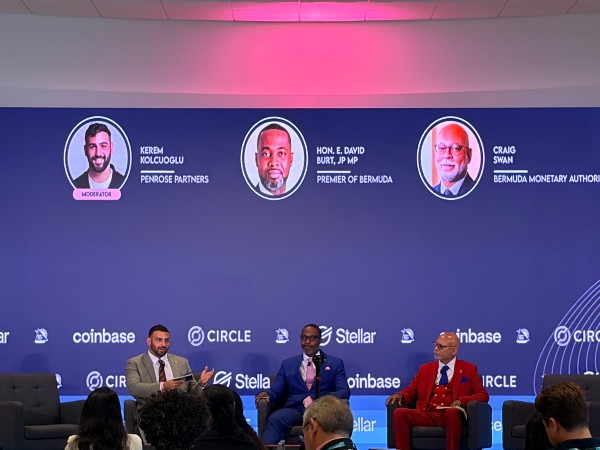
Fireside Chat at the Bermuda Digital Finance Forum on May 13th
BMA has tested these processes and permit them in clearly defined channels. The cautious innovation with industry has resulted in sixty companies licensed under Digital Asset Business Act [DABA]. BMA has a culture of an approachable, accessible regulator with highly qualified personnel, noted Premier Burt. CEO Swan explained that there is a balance to enable the firms to flourish while protecting customers of financial services, which is the BMA’s primary mission. Bermuda as developed a track record of being forward looking which is recognized around the world. The Premier thanked Swan and his team. The Premier then explained there will be a ‘continued triangle of government, regulator, and industry’ for DiFi after he departs.
Nouriel Roubini Chief Economist and Portfolio Manager of Atlas Capital
Nouriel Roubini a renown authors of ‘Megatrends’ in 2022 and Chief Economist and Portfolio Manager of Atlas Capital Team. He sited 10 threats, including Geopolitics, Debt, Inflation, and Climate change amongst others. US Dollar has been following a downward trend from 150 in 1985 to 98 today, per the DXY index. DXY was originally developed by the U.S. Federal Reserve in 1973, to measure trade-weighted average value of the U.S. dollar against global currencies.
Roubini has engaged with Atlas Captial to react a new defensive asset that is designed to be defend against the 10 threats. Ar risk from the US the twin deficits of budget and debt is the ongoing devaluation. The US Stable Coin is a digital version of a sovereign currency, as are many Central Bank digital currencies. The Atlas token is not connected to a sovereign currency but invests in the assets that rise on a declining dollar.
“There is a demand for tokenized assets that are available digitally, and not tied to their local currency, with positive turns and high returns in difficult times,” elaborated Roubini. Safety, security, and outright custody in digital token enables settlement and clearing almost immediately. A Tokenized Real Assets tied to water, minerals, or climate solutions, will advert the problems from the weak crypto, which he calls “vapour wear”. On a reflection over the last several years in digital tokens and crypto he explains “Much is the junk is gone and the good ones remain.”
Sandy Kaul, head of innovation at Franklin Templeton [FT] Investments
Sandy Kaul, head of innovation at behemoth Franklin Templeton Investments led an afternoon roundtable of professionals on the topic of Tokenization. There are three models of tokenization and Franklin Templeton has pursued two. The first is a digitally native token, where the token is the actual record on blockchain with no additional data offchain record. It settles automatically and is 100% based on a digital wallet.
The second is where a digital twin of the token sits offchain and requires overnight trading or T+1. The token is the receipt recorded in traditional ledger. There is no Person to Person [P2P], such as a Zelle payment that people in the US use to transfer money directly. FT has created a P2P zelle-like tokens that transfers with a partial day yield. It is utilized for the money market accounts. The FT digital money market is digitally native. FT built a special system for virtual 24/7 hr trading. This is especially pertinent for their global institutional investment base.
The third type of token is blended off-on the blockchain or a synthesized product. An asset owner puts its asset in a Trust Company to be purchased by a third party who issues a token to be traded in the financial markets. For example, FT has placed assets of some of their mutual or EFT funds into trust with the Depositary Trust Company in the US, the largest and most reputable. The Kraken exchange issued BENJI tokens for fund assets and offers them on the Kraken Digital Exchange. They are permissionless as the institution does not sign-off on each exchange. They are based on a ‘Know Your Token’ [KYT] compliance certification. This third model emerged mid-2025.
Steven Rees Davis of Carey Olsen Law Firm
DiFi in Insurance
The Digital Asset Business Act or DABA covers digitalisations. There is also a Digital Asset Issuance Act [DAIA]. There have been Amendments to Bermuda’s Insurance Act 1978 in 2022 that explicitly permits the use of digital assets for underwriting risk and holding capital. BMA has issued a recent discussion paper. “The early stage of infrastructure and capital coming to the market had been slow to develop, but it is happening”, according to Steven Rees Davis of Carey Olsen Law Firm. He led a Roundtable on DiFi in Insurance.
DiFi is complimentary to the insurance market from a regulatory and compliance standpoint. They use different banking rails. The token model is a protocol and creates ‘smart’ assets. How do you know you actually own the underlying or what is it values? There are proofs that can be set, such as Chainlink or a secondary validator. There is need to liquidity and assets in insurance contracts.
There are stoppers and adaptations for regulation and in practice. Solvency II Framework insurances strict adherence. Only specific type of insurance and classes can transact in DiFi. “Most normal contract are designed to fail whereas DiFi is fully ring fenced and transparently collateralized,” said Andre Perez, chairman and CEO of the Nascent Group, an independent, technology-driven service provider to the financial industry. Tokenized insurance will become a billion-dollar business in the next few years.
From an asset management perspective, digital products can be issued to be distributed globally. Most trading in financial market is secondary and there is no question on the underlying asset. Bermuda based COINBASE operates in many countries and launched the international trading exchange. Similar to the familiar traded Insurance Linked Security [ILS] of which the BSX is predominate, assets are held by a reputable trust company.
The Bank of New York or BONY is the trust company for ILS and is considering handling tokenized assets according to Perez. There is a look-through from tokens to assess the collateral. ILS is securitized on an offchain world. DAIA insurance can by issued with ownership by a Special Purpose Insurance [SPI] Policy with the option to pay out or return capital. There is a look through basis from the tokens to the underlying assets as collateral. The clients’ questions are how can I lose money and how am I protected.



Read More About
Category: All, Business, technology


